



How does ChatGPT work?
ChatGPT works by predicting the most useful next words of a reply with a large language model trained on huge amounts of text. The first version was fine-tuned from a GPT-3.5 series model using reinforcement learning from human feedback (RLHF), as OpenAI explained in its launch post. Human trainers ranked answers, and the model learned to prefer helpful, safe responses.
Today ChatGPT combines three layers: the language model itself, tools (web search, file analysis, image generation, code execution) and memory of the conversation. When a question needs fresh facts, ChatGPT decides to run a web search and then writes an answer with source links.
ChatGPT history and key facts
ChatGPT grew from a research preview into a mass product in under four years. The table lists the milestones that matter most for marketers.
| Date | Milestone |
|---|---|
| 30 Nov 2022 | Public launch as a free research preview based on GPT-3.5 |
| March 2023 | GPT-4 becomes available to paying users |
| May 2024 | GPT-4o adds fast multimodal (text, voice, image) answers |
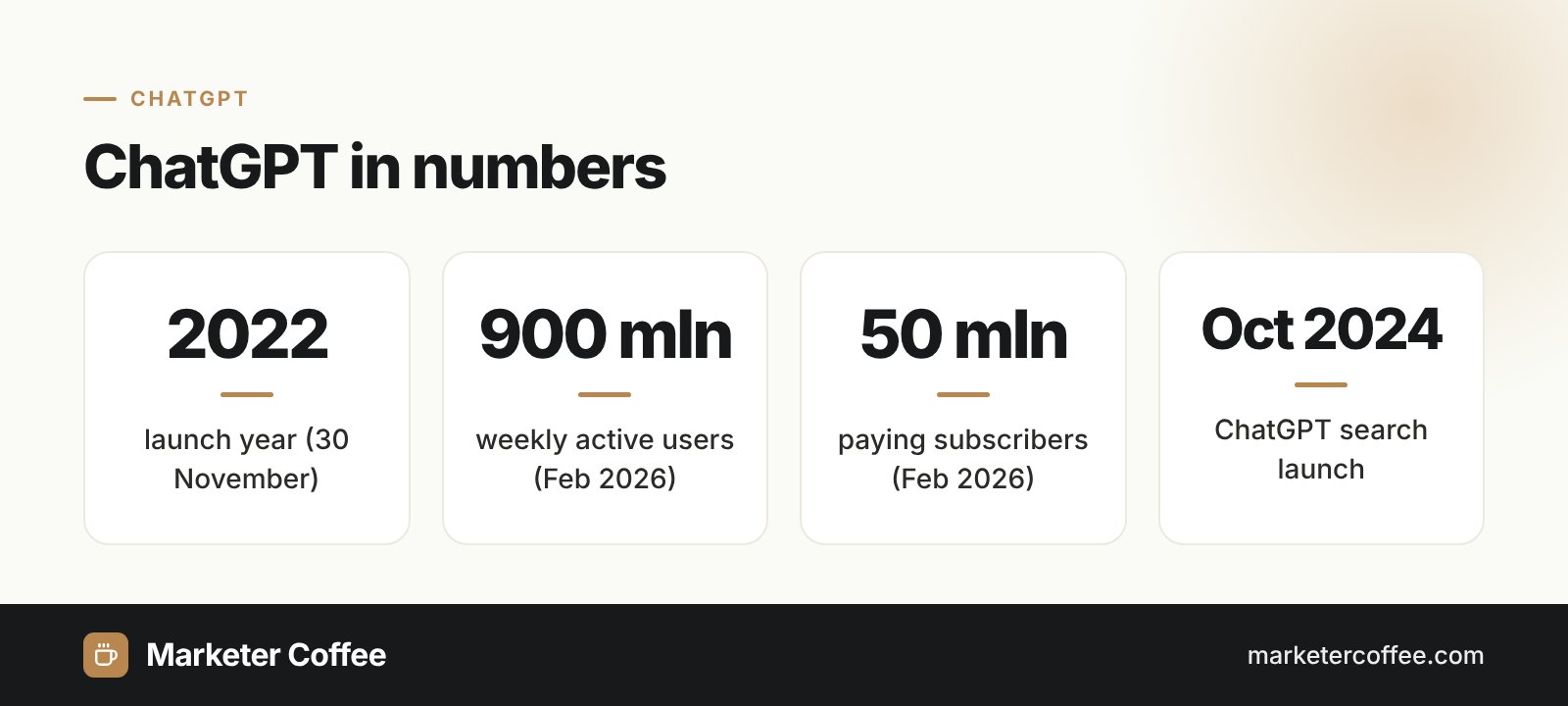
| 31 Oct 2024 | ChatGPT search launches with linked sources |
| August 2025 | GPT-5 becomes the default model |
| October 2025 | ChatGPT Atlas browser launches; 800 million weekly users |
| February 2026 | 900 million weekly users and 50 million paid subscribers |
Main features of ChatGPT
ChatGPT offers four groups of features that cover most marketing work: writing, research, analysis and automation.
Conversation and writing
ChatGPT drafts emails, briefs, product descriptions and ad copy, and it keeps context across follow-up questions. It is a far more capable successor of the classic rule-based chatbot.
Web search with sources
ChatGPT search, launched on 31 October 2024, answers questions with current web results and clickable citations. OpenAI opened it to all logged-in users in December 2024 and to everyone without sign-up in February 2025.
Files, data and images
Users upload spreadsheets, PDFs and screenshots, and ChatGPT summarises them, builds charts or writes code to clean the data.
Agents and the Atlas browser
Agent features let ChatGPT complete multi-step tasks online, such as comparing offers or filling forms. Atlas, OpenAI’s browser from October 2025, builds this assistant directly into web navigation.
ChatGPT in marketing, SEO and AI search
ChatGPT matters to marketers because it is now a search channel where brands are recommended or ignored. When someone asks for “the best CRM for a small agency”, ChatGPT composes one answer and cites a handful of sources. This is the core of Generative Engine Optimization (GEO), the practice of earning mentions in AI answers, which sits next to Google’s AI Overviews.
In my AI SEO projects I see three levers that decide whether a brand appears in ChatGPT:
- Crawl access: OpenAI’s documentation states that sites blocking OAI-SearchBot do not appear in ChatGPT search answers.
- Entity clarity: consistent brand facts across your site, profiles and third-party pages help the model connect you to a topic (see my guide to entity SEO).
- Citable content: definitions, numbers and comparison tables are easy for the model to quote.
ChatGPT vs other AI assistants
ChatGPT competes mainly with Google Gemini and Perplexity, and each one rewards slightly different content.
| Assistant | Owner | Strength for marketers |
|---|---|---|
| ChatGPT | OpenAI | Largest audience, search with citations, agents |
| Google Gemini | Integration with Google Search, Gmail and Android | |
| Perplexity AI | Perplexity | Answer engine with sources shown up front |
Pros and cons of ChatGPT
ChatGPT saves hours on research and drafting, but its output needs a human editor.
- Speed: drafts and summaries appear in seconds.
- Reach: the largest user base of any AI assistant.
- Errors: the model sometimes states wrong facts with full confidence, so every number needs checking.
- Sameness: unedited AI copy reads generic and rarely ranks or gets cited.
Frequently asked questions about ChatGPT
When was ChatGPT released?
OpenAI released ChatGPT on 30 November 2022 as a free research preview. The first version ran on a GPT-3.5 series model fine-tuned with human feedback.
How many people use ChatGPT?
ChatGPT had 900 million weekly active users in February 2026, according to TechCrunch. At the same time it had 50 million paying subscribers.
Is ChatGPT a search engine?
ChatGPT works as a search engine when its web search is active, because it then answers with current results and source links. It is still primarily an AI assistant that also writes, analyses files and runs tasks.
How do I get my website cited in ChatGPT?
Allow OAI-SearchBot in robots.txt, publish clear and factual content, and keep your brand information consistent across the web. Mentions on trusted third-party sites also raise the chance of being cited.
Related terms
- Introducing ChatGPT · OpenAI
- ChatGPT reaches 900M weekly active users · TechCrunch
- Introducing ChatGPT search · OpenAI
- Overview of OpenAI crawlers · OpenAI
- Wiemy, jak Polacy korzystają z ChataGPT · Spider's Web (dane Gemius/PBI)
- ChatGPT · Wikipedia
