What is query fan-out?
Query fan-out is the step where a language model rewrites a user’s prompt into many narrower searches before it writes a response. Instead of matching one query to one results page, the system looks for subtopics, comparisons and follow-up needs hidden in the question. Google Search Central describes it as issuing multiple related searches across subtopics and data sources to build a response for AI Overviews and AI Mode.
How does query fan-out work?
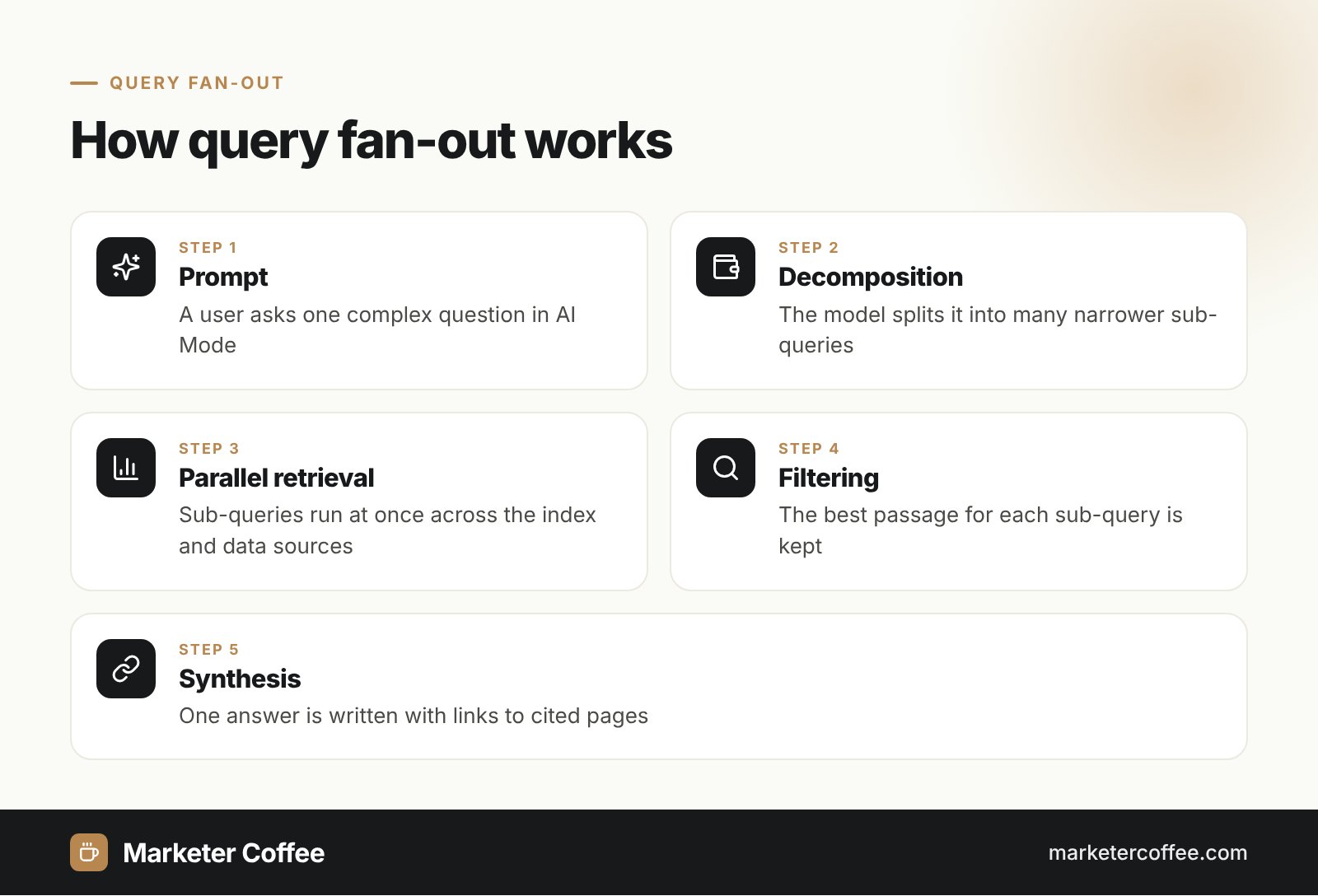
Query fan-out works in four stages: decomposition, parallel retrieval, filtering and synthesis. The H3s below describe each stage in the order Google’s system runs them.
Decomposition
The model reads the prompt and splits it into sub-queries. A prompt such as “best CRM for a 10 person agency in Poland” becomes searches about pricing, Polish language support, integrations and reviews.
Parallel retrieval
The sub-queries run at the same time against the web index and Google’s structured sources. Robby Stein, Google’s VP of Product for Search, told Search Engine Journal that the system also draws on the Shopping Graph, which holds about 50 billion product listings.
Filtering
The system keeps passages that answer a sub-query well and discards weak or duplicate ones. This is why one page can win a citation for a single subtopic without ranking for the main query.
Synthesis
The model, a custom version of Gemini 2.5 at the 2025 launch, writes one answer and attaches links to the supporting pages.
Key facts about query fan-out
| Fact | Detail |
|---|---|
| Public launch | Google I/O, 20 May 2025 (AI Mode, United States) |
| Model | Custom Gemini 2.5 in Search |
| Deep Search scale | Hundreds of searches per prompt |
| Used in | AI Mode, AI Overviews, Deep Search |
| Extra technical requirements | None, a page must be indexed and eligible for a snippet |
Query fan-out vs classic search
Query fan-out differs from classic search because one prompt triggers many retrievals instead of one.
| Aspect | Classic search | Query fan-out |
|---|---|---|
| Queries per prompt | One | Many, run in parallel |
| Output | List of ten blue links | Written answer with cited sources |
| Unit that wins | Whole page | Passage that answers a sub-query |
| Visibility metric | Ranking position | Citation share in AI answers |
Query fan-out in SEO and AI search
Query fan-out matters to marketers because it rewards pages that cover a topic’s sub-questions, not only its head keyword. In my AI SEO projects I map the likely sub-queries for each money page and check which ones the page answers in a clear, quotable paragraph. The same logic drives generative engine optimization: tools like ChatGPT and Perplexity also rewrite prompts into several searches before answering.
- List the questions a buyer asks before, during and after the main query.
- Answer each question in its own section with the answer in the first sentence.
- Add comparison tables, prices and specifications that a model can lift as facts.
- Mark up entities consistently so the model links your brand to the topic, as described in my entity SEO guide.
How to measure visibility in query fan-out
Visibility in query fan-out is measured by how often your pages are cited across a set of tracked prompts, not by one ranking position. Google Search Console counts AI Mode and AI Overviews traffic inside the regular Web search report, so clicks from cited links appear there without a separate filter. I track a fixed list of 30 to 50 prompts per market, log which domains AI Mode cites for each one and compare that share month to month, as described in my guide to measuring SEO results.
Frequently asked questions about Query fan-out
What is query fan-out in Google AI Mode?
Query fan-out is the technique Google AI Mode uses to split one question into many sub-searches that run in parallel. The results are merged into one answer with links to supporting pages.
When did Google introduce query fan-out?
Google described query fan-out publicly at I/O on 20 May 2025, when AI Mode rolled out to everyone in the United States. Deep Search uses the same technique at a larger scale.
How do I optimise content for query fan-out?
Cover the sub-questions around your main topic, each in a clearly headed section with a direct answer. Google says no special markup is needed, only that the page is indexed and eligible for a snippet.
Does ChatGPT use query fan-out?
ChatGPT search and Perplexity also rewrite one prompt into several web searches before they answer. Google is the company that popularised the name query fan-out.
Related terms
- AI in Search: Going beyond information to intelligence · Google (The Keyword)
- AI features and your website · Google Search Central
- Query Fan-Out Technique in AI Mode: New Details From Google · Search Engine Journal
- AI Mode już w Polsce. Wyszukiwarka Google nauczyła się nowych sztuczek · Benchmark.pl