




The best email marketing services in 2026 are Klaviyo and Omnisend for online stores, MailerLite and Brevo for small businesses watching costs, ActiveCampaign and HubSpot for B2B companies with a sales process, and Kit for creators. I am Adrian Dąbrowiecki, founder of Marketer Coffee, an SEO agency for SaaS and ecommerce brands, and I see email from the side of what happens after a visitor arrives from search: whether the store or the product can bring them back. Below are ten services with prices checked today, what each is best at, where each one gets expensive, and how to pick one for your business model.
The biggest change this year is that free plans keep shrinking while AI moves into every tool. Mailchimp cut its free plan to 250 contacts and 500 emails a month in January 2026. At the same time MailerLite, Kit, beehiiv and ActiveCampaign all launched MCP servers or connectors, so you can ask Claude or ChatGPT to compare campaigns or draft an automation straight from your account data.
What Is an Email Marketing Service?
An email marketing service is software that stores your contacts, lets you design and send campaigns and automated emails to them, and reports what those emails produced in opens, clicks and revenue.
Every service on this list does the basics: a list, an editor, sign-up forms, scheduled campaigns and simple automations. The differences sit in three places. The first is data: an ecommerce tool like Klaviyo reads every product view and order from your store, while a general tool sees only what you send it. The second is automation depth, from a single welcome email to multi-branch journeys driven by product events. The third is the pricing model, which can be by contacts, by emails sent or by seats, and which decides what you pay once the list grows.
If your emails are the product, a newsletter platform is often a better fit. I cover those separately in the ranking of the best newsletter platforms.
How I Chose These Tools
I compared the services on four things: how well they use customer data, how far their automation goes, what they cost at a realistic list size, and how easy they are for a small team to run without a specialist.
Every price was checked on the vendor’s own pricing page on 14 October 2026. Several vendors, including Klaviyo, Brevo, ActiveCampaign and HubSpot, did not display prices in the page content I could read, so for those I give third-party figures marked “about” and name the source. Ratings come from G2. None of the links here are affiliate links.
For online stores, automation is where the money is. In Omnisend’s 2026 Ecommerce Marketing Report, based on 2025 platform data, automated emails were about 2% of email sends but produced 30% of email-driven revenue, earning $2.87 per send against $0.18 for scheduled campaigns. Those are a vendor’s own numbers, but they match the general pattern: welcome, abandoned cart and post-purchase flows outperform one-off blasts by a wide margin.
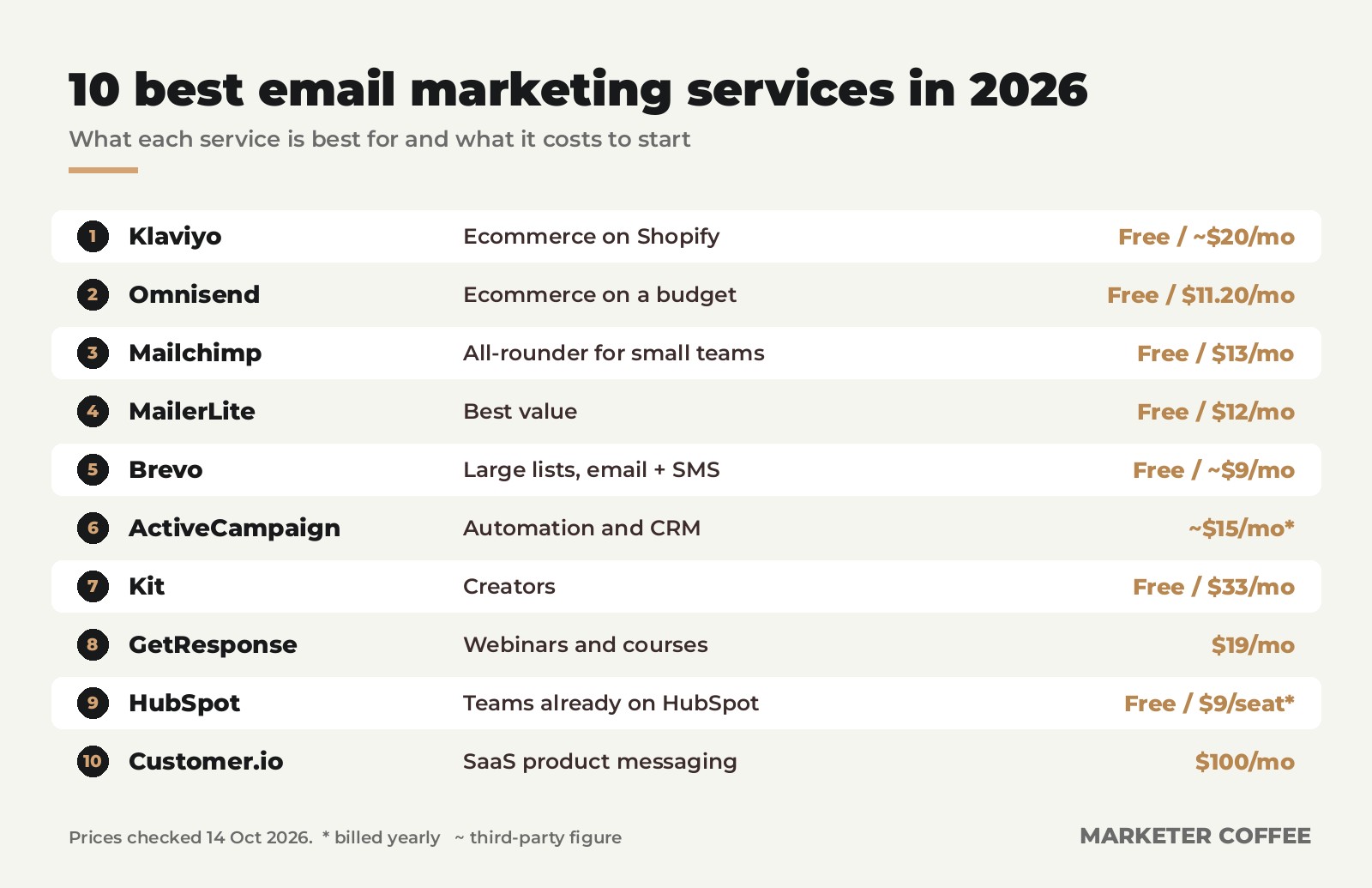
10 Best Email Marketing Services in 2026
The services are ranked by how much revenue they can help a typical small or mid-sized business produce from email, with ecommerce weighted heavily because that is where email pays most directly.
| Tool | Best for | Starting price | Free option |
|---|---|---|---|
| Klaviyo | Ecommerce brands, especially Shopify | About $20/mo (500 profiles) | 250 profiles, 500 sends |
| Omnisend | Ecommerce on a budget | $11.20/mo (500 contacts) | 250 contacts, 500 emails |
| Mailchimp | All-rounder for small teams | From $13/mo | 250 contacts, 500 emails |
| MailerLite | Best value for small business | From $12/mo | 250 subscribers |
| Brevo | Large lists, email plus SMS | About $9/mo (5,000 emails) | 300 emails per day |
| ActiveCampaign | Automation and CRM | About $15/mo, billed yearly | 14-day trial |
| Kit | Creators selling products | $33/mo (Creator) | Up to 10,000 subscribers |
| GetResponse | Webinars, courses and funnels | $19/mo (Starter) | 500 contacts (third-party) |
| HubSpot | Teams already on HubSpot CRM | About $9/seat/mo, billed yearly | 2,000 emails a month |
| Customer.io | SaaS product messaging | $100/mo (Essentials) | No |
1. Klaviyo
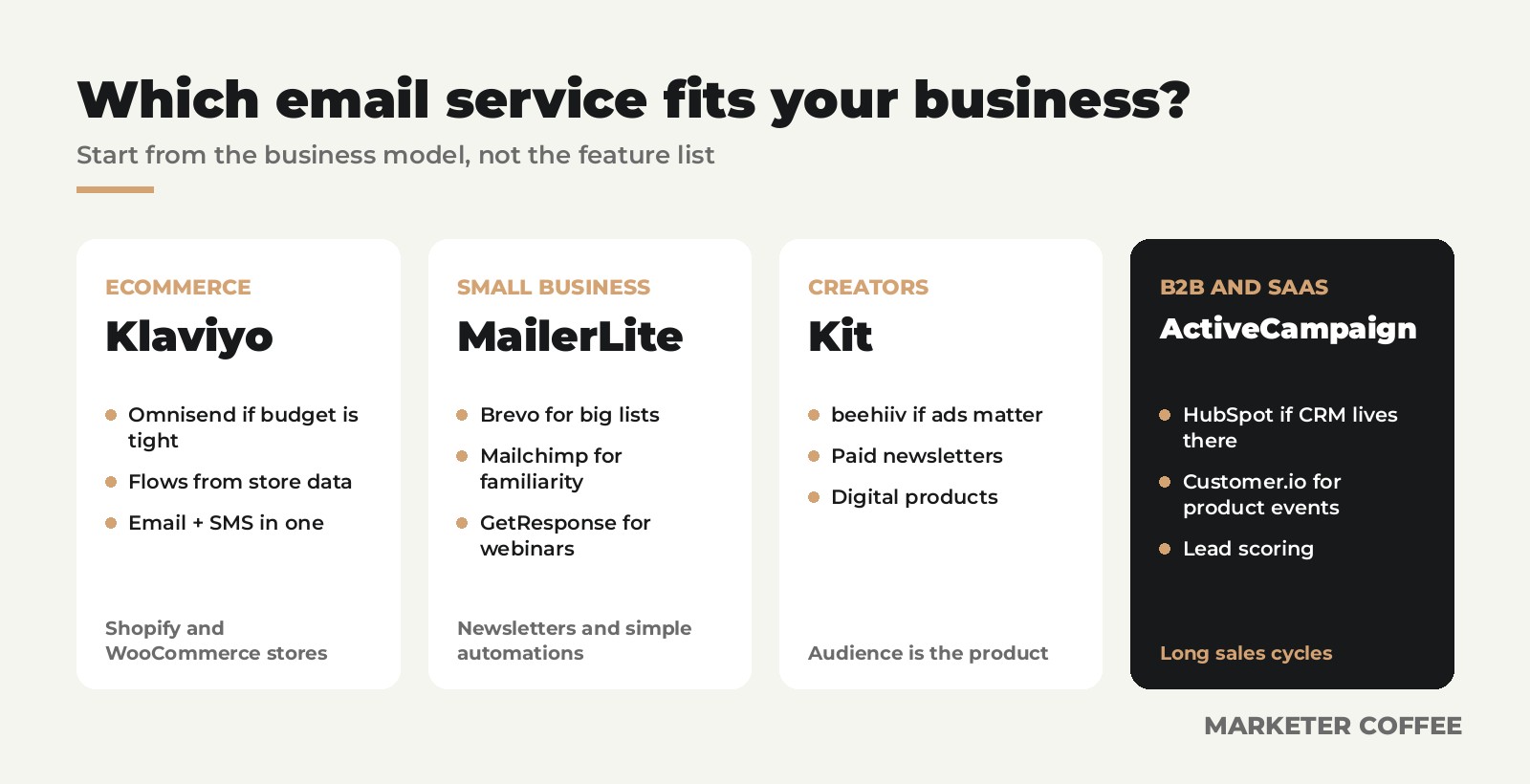
Klaviyo is the default email platform for serious online stores, and for good reason. It pulls every browse, add-to-cart, order and refund from your store and turns it into segments and flows you can act on. Abandoned cart, browse abandonment, back-in-stock, win-back and post-purchase flows all come as templates that already know your catalogue.
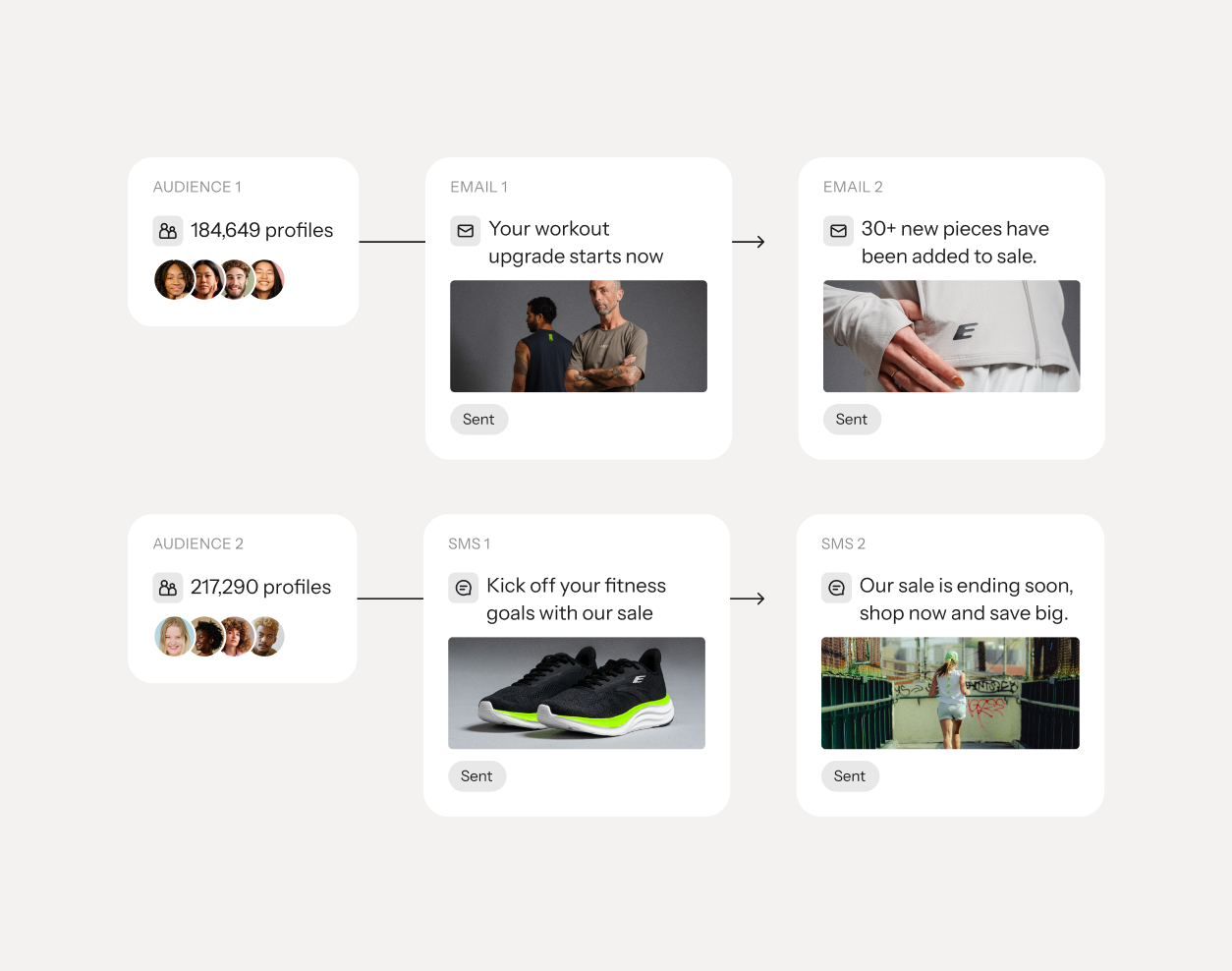
It has grown into a wider platform with SMS, push, a customer data platform, analytics, a helpdesk and AI agents for marketing and customer service. For a brand doing real volume, the predictive analytics, such as expected next order date and customer lifetime value, are the features that pay for the subscription.
The cost is the issue. Klaviyo bills by active profiles, a model it formalized in 2025, so a growing list means a growing bill whether or not those people buy. Third-party trackers list $30 a month at 1,000 profiles and $150 at 10,000 for email alone. Its pricing page uses a calculator that did not show figures in the content I could read, so check your own list size there. It is also more than a small store with a few hundred orders a month needs.
Pick Klaviyo if you run a store with steady revenue and want email and SMS to do real selling.
2. Omnisend
Omnisend covers most of what a store needs from Klaviyo at a lower price. Pre-built automations for welcome, abandoned cart, browse abandonment and post-purchase work out of the box with Shopify, WooCommerce, BigCommerce and Wix, and the editor makes product blocks easy to drop into campaigns.
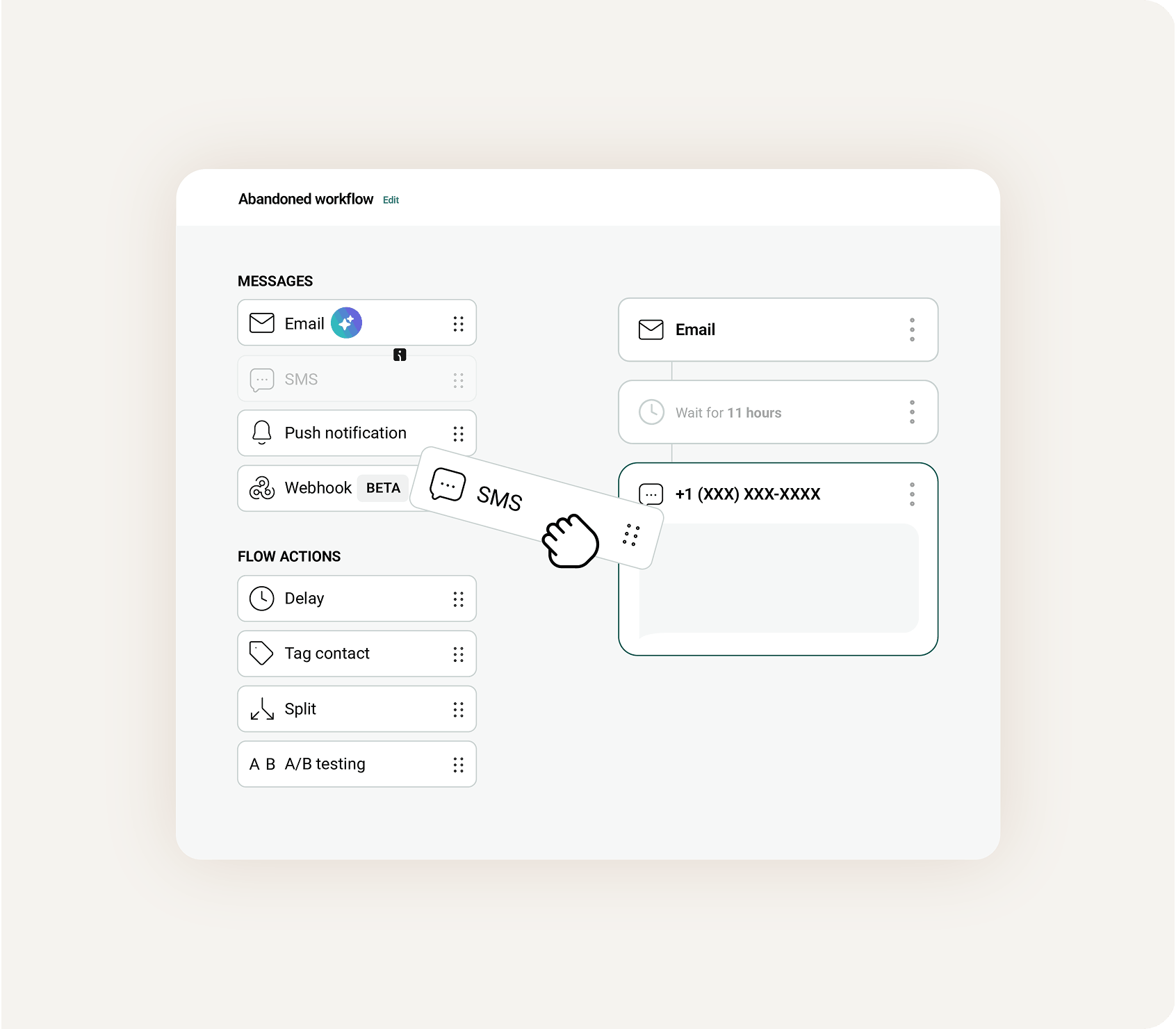
The Pro plan includes unlimited email sends, SMS and bonus SMS credits equal to your monthly bill. Omnisend also publishes one of the more useful annual reports on ecommerce email, which is where the automation figures earlier in this article come from.
Its segmentation and analytics are simpler than Klaviyo’s, and large brands with complex data will feel the limits. The pricing page shows Standard at $11.20 a month while its meta description says plans start at $16, so confirm the figure for your contact count. Pick Omnisend if you want ecommerce automation without Klaviyo’s bill.
3. Mailchimp
Mailchimp, now part of Intuit, is the tool most small businesses have heard of, and it is still a sensible middle choice. It connects to almost everything, has a good editor and templates, and the Standard plan adds predictive segmentation, dynamic content and generative AI at no extra cost. For a business that sells a bit online, runs events and sends a monthly update, it covers the ground.
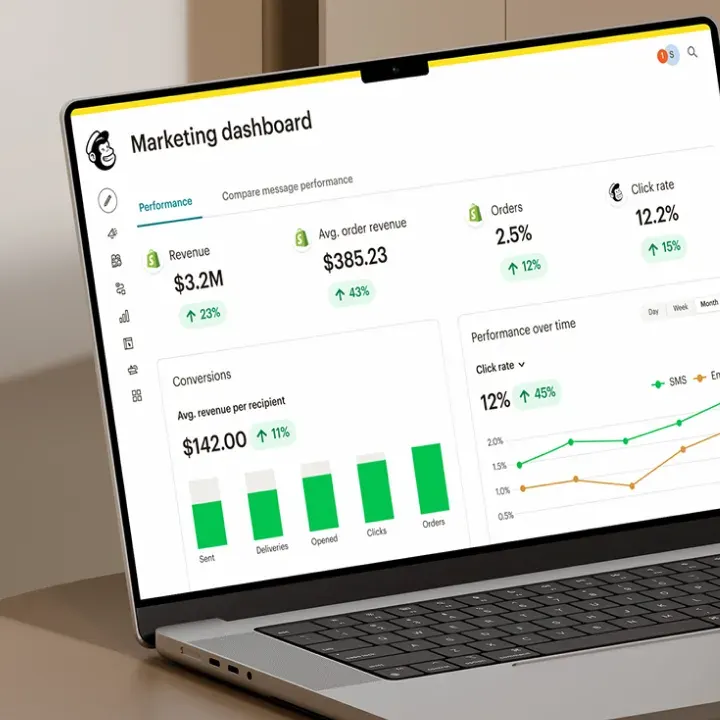
The free plan is now close to useless for real work: 250 contacts, 500 emails a month, no scheduling and no automation flows. Essentials allows only four steps per flow. The jump from Standard to Premium, at $350 a month, is steep, and contact-based billing means you should clean inactive subscribers regularly or pay for them. The pricing page lists sends per plan as multiples of your contacts.
Pick Mailchimp if you want a familiar tool that does many things reasonably well. For pure ecommerce, Klaviyo and Omnisend do more.
4. MailerLite
MailerLite gives a small business most of Mailchimp’s useful features for less, in a cleaner interface. Automations, landing pages, sign-up forms, a website builder, paid newsletters, digital products and an ecommerce integration with Shopify and WooCommerce are all included, and the Power plan has unlimited sends under a fair use policy.

It is also ahead on AI connections. Its MCP server works with Claude and ChatGPT, and full MCP and API access starts on the first paid plan, so you can ask an assistant which campaigns underperformed or have it build a re-engagement automation as a draft.
Ecommerce automation is basic compared with Klaviyo or Omnisend, and the free plan has dropped to 250 subscribers. The pricing page shows only starting prices, so use the slider to see your real cost. Pick MailerLite if you want a simple, affordable tool that a non-specialist can run.
5. Brevo
Brevo, the former Sendinblue, charges by emails sent rather than contacts stored. For a business with a large list that emails it once or twice a month, that makes it far cheaper than contact-based tools. It also covers transactional email, SMS, WhatsApp, a CRM, loyalty features on higher plans and a set of AI agents for marketing, sales and data analysis.
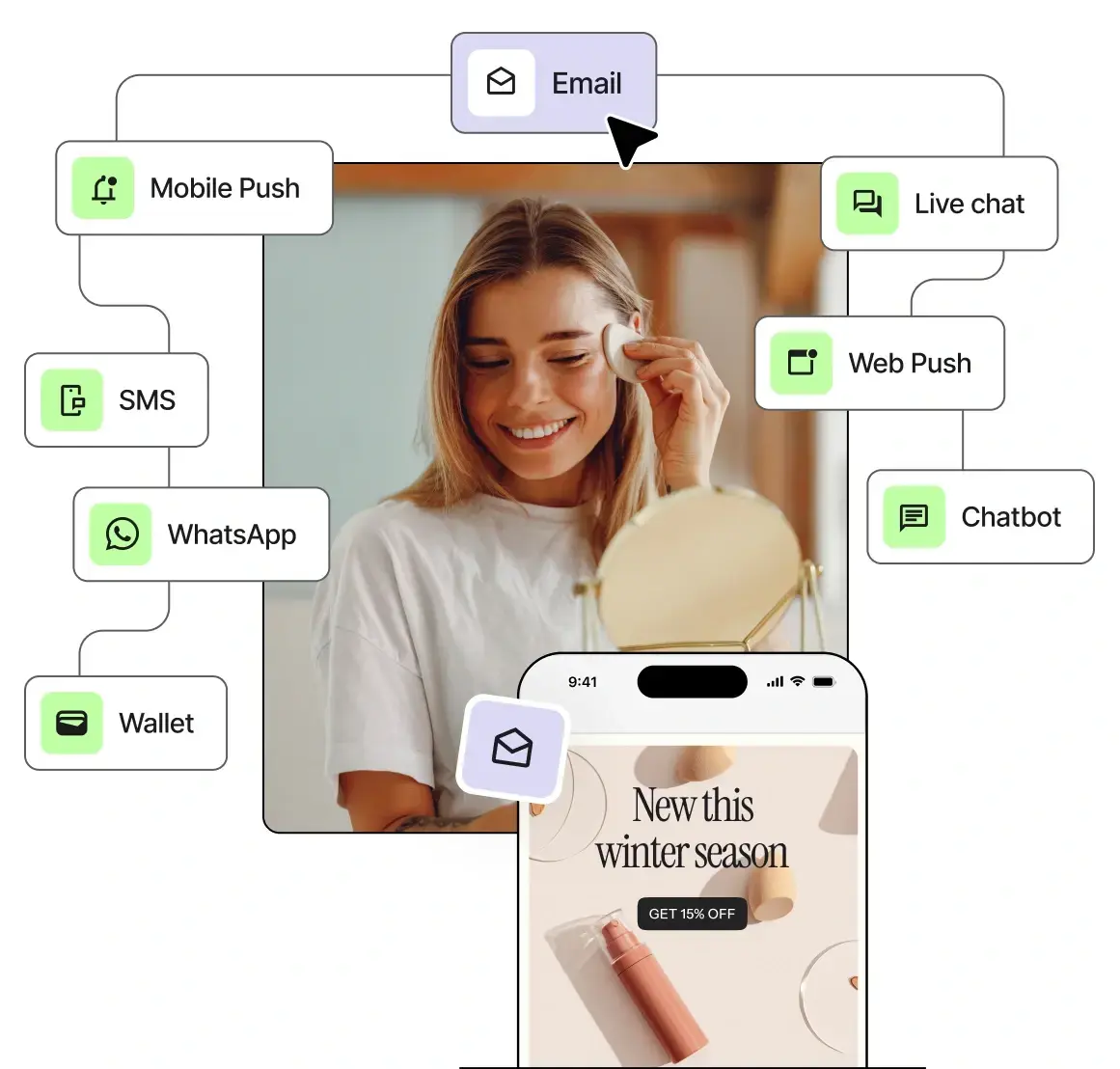
Brevo is a French company and a common choice for European businesses, which matters to some clients for data residency reasons. The Professional plan adds ecommerce features, contact scoring and phone support.
The free plan’s 300 emails a day makes it slow for anything but small lists, and the interface packs a lot into menus. The pricing page did not render prices for me, so the figures above come from a third-party comparison dated November 2025. Pick Brevo if your list is large and your sending is infrequent.
6. ActiveCampaign
ActiveCampaign is the automation specialist. Its builder handles branching journeys, lead scoring, site and event tracking and conditional content better than anything else in its price range, and the built-in CRM connects email behaviour to deals. For a B2B company or a service business with a sales cycle, it turns email into part of the sales process rather than a broadcast channel.
In 2026 it leaned hard into AI. Active Intelligence suggests and builds campaigns, keeps a memory of your brand and best-performing emails, runs scheduled tasks, and connects to ChatGPT and Claude so you can work with your account from an assistant.
The learning curve is real, Starter limits automations to five actions each, and the pricing page did not display prices in the content I could read, so the figures above come from a third-party tracker. Pick ActiveCampaign if automation and lead nurturing matter more to you than design or ecommerce depth. For SaaS teams, it pairs well with a content programme built for B2B SaaS SEO.
7. Kit (formerly ConvertKit)
Kit is built for creators, and its free plan is the most generous among email services: up to 10,000 subscribers with unlimited broadcasts, landing pages, forms and the ability to sell digital products and subscriptions. Visual Automations make it easy to move people from sign-up to a sales sequence based on what they click.
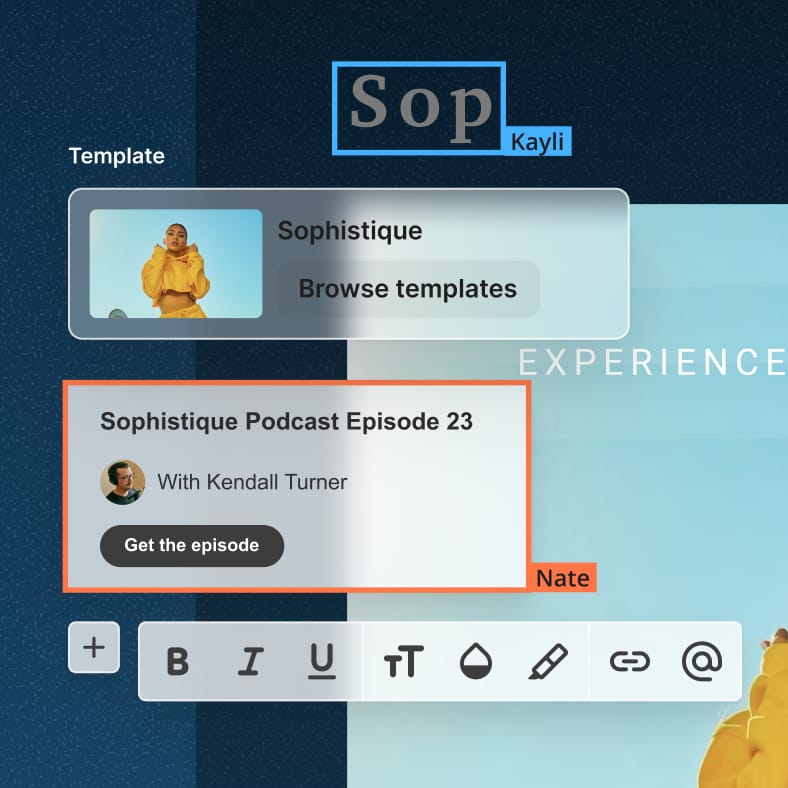
It is not an ecommerce platform in the Klaviyo sense, and its paid plans get expensive as the list grows. The pricing page shows Pro at $50 for the first year with $66 listed beside it, so expect a higher renewal. Pick Kit if your audience is the business and your products are digital.
8. GetResponse
GetResponse is one of the oldest names in email marketing, and it started in Poland, in Gdańsk, in the late 1990s. That makes it a natural first look for Polish and Central European companies, with local-language support, and it still serves businesses worldwide. What sets it apart today is breadth: email, automation, landing pages, a website builder, webinars, a course creator and paid newsletters with 0% transaction fees, all in one account.
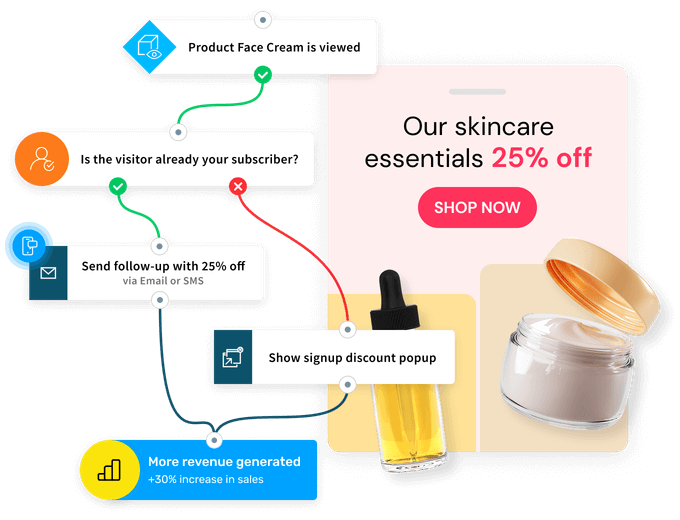
For a coach, trainer or B2B company that runs webinars to generate leads, having the webinar, the follow-up sequence and the landing page in one place removes a lot of integration work. Every paid plan includes unlimited monthly email sends.
The interface tries to do a lot and feels busier than MailerLite’s, and the ecommerce features are not at Klaviyo’s level. The pricing page did not list the free plan or contact limits in the content I read; a third-party review dated August 2026 gives 500 contacts and 2,500 emails a month free and a 14-day trial. Pick GetResponse if webinars or courses are part of how you sell.
9. HubSpot Marketing Hub
HubSpot’s email tool is rarely the best email tool, but it is often the right one, because it lives inside the CRM. Every email, form and page view lands on the contact record your sales team already uses, and lists, lead scoring and reporting run off the same data. For a B2B company with sales reps, that shared view is worth more than a better editor.
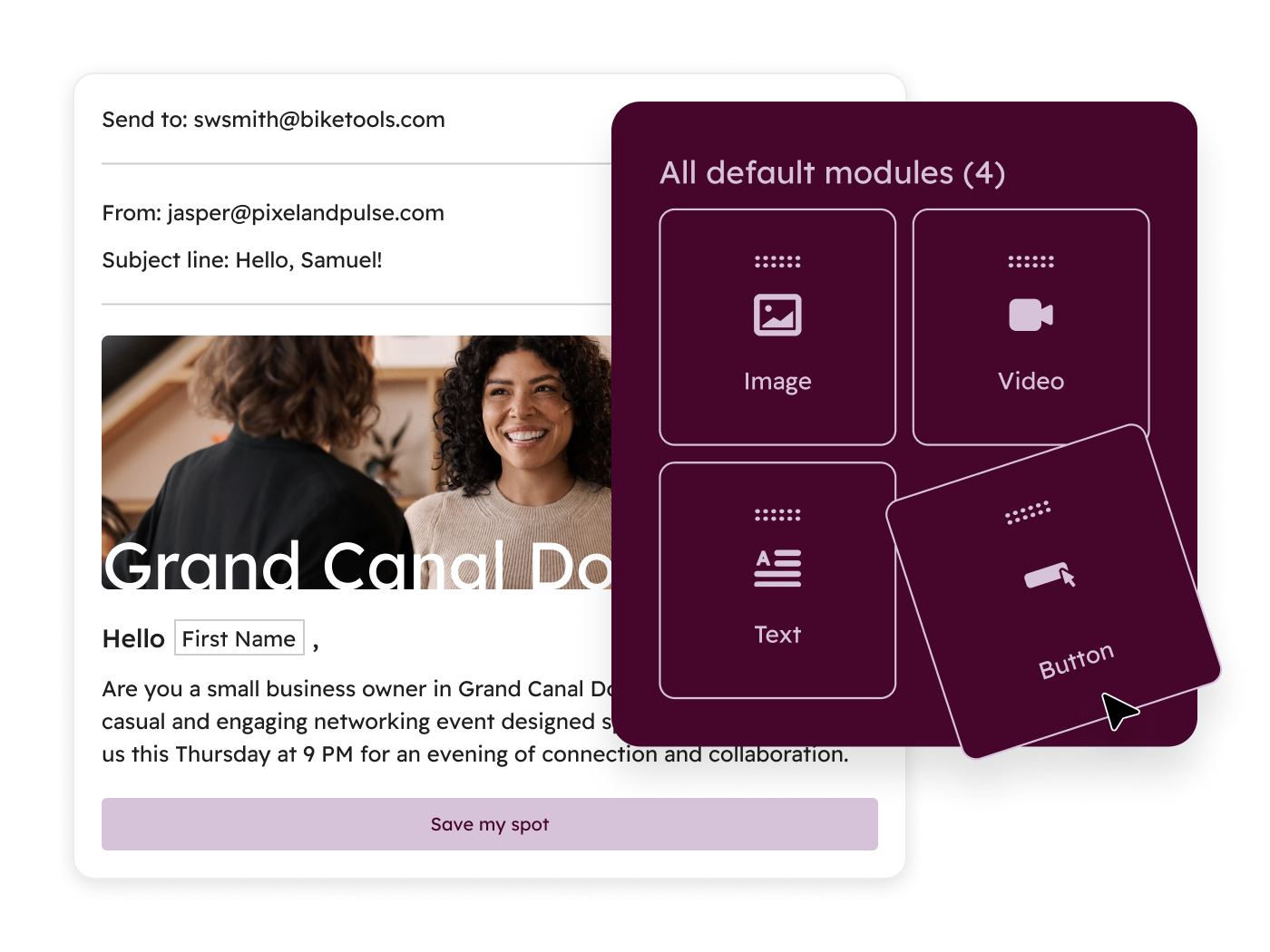
Starter is cheap. Professional, where real automation begins, is not: HubSpot’s own blog lists $800 a month on yearly billing plus a one-time $3,000 onboarding fee. The pricing page did not show figures in the content I read, and the blog itself was inconsistent about Starter’s monthly price, so check before you budget. Pick HubSpot if your sales team already works in it.
10. Customer.io
Customer.io is built for product teams rather than marketers. It sends email, push, SMS and in-app messages triggered by what users do inside your product: signed up but did not finish setup, used a feature for the first time, stopped logging in. For a SaaS company, those onboarding and activation journeys often matter more than any newsletter.
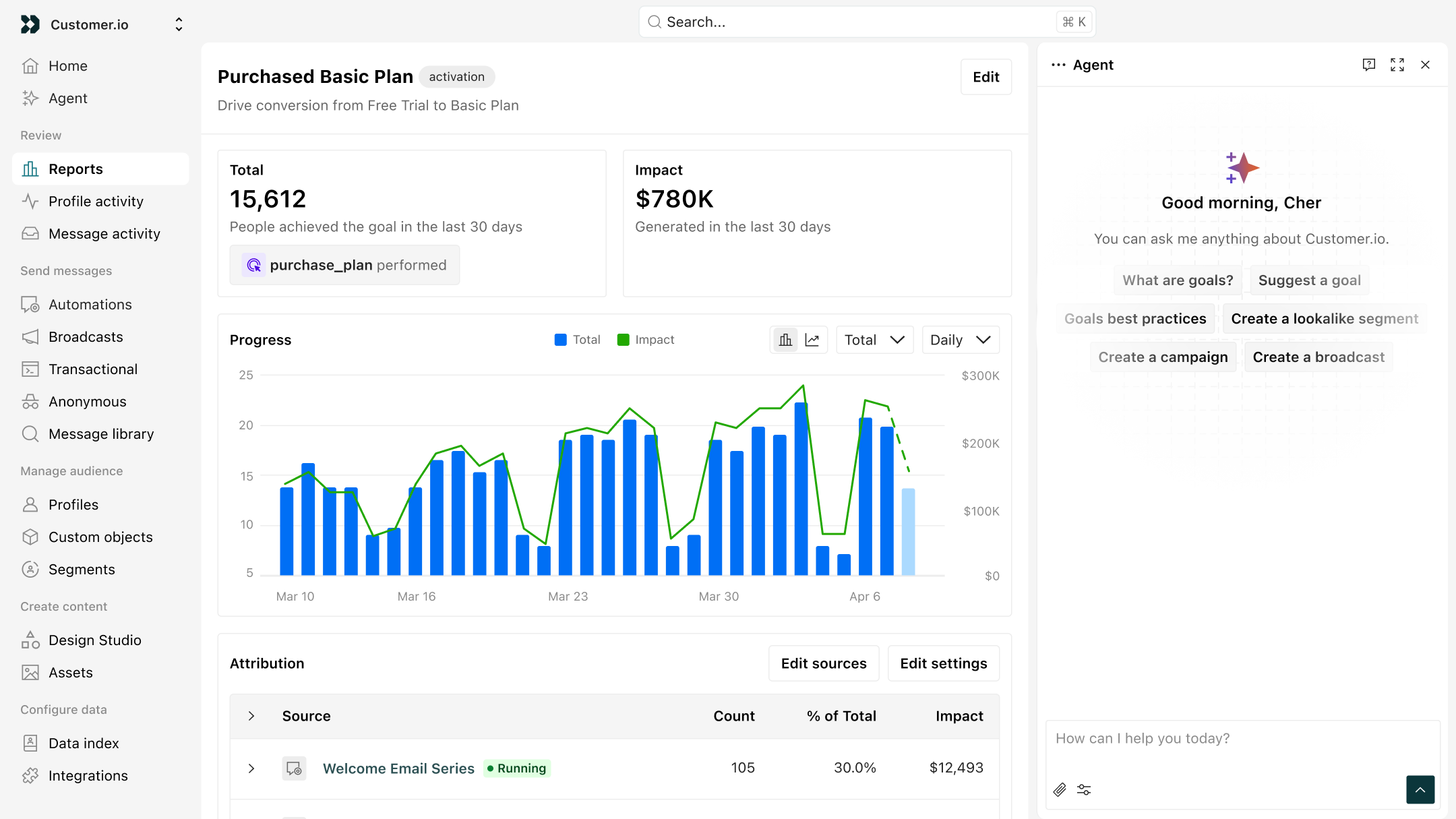
It needs developer help to send events and data in, which is the price of its flexibility. At $100 a month to start it is not for small lists, though the pricing page mentions a startup programme that gives companies that raised under $10 million a year free. Pick Customer.io if your emails depend on product usage data.
What Is the Best Email Marketing Service for Ecommerce?
Klaviyo is the best email marketing service for ecommerce in 2026, and Omnisend is the best choice for smaller stores that want similar automations at a lower price.
Both connect directly to Shopify, WooCommerce and other platforms, read product and order data, and ship the flows that make most of a store’s email revenue: welcome, abandoned cart, browse abandonment, back-in-stock and post-purchase. Omnisend’s report found that abandoned cart and welcome emails together drove 76% of orders generated by automations in 2025, and that back-in-stock automations had the highest conversion rate of any type, at 6.46%.
Email only works on the traffic you already have. For most stores, search is the largest source of new visitors that email can then bring back, which is why I would plan the two together. My approach to the search side is in the guide to ecommerce SEO, and the Galeria Zapachu case study shows how technical quick wins lifted a perfume store’s traffic by 84% in 28 days.
What Is the Best Free Email Marketing Service?
The best free email marketing service is Kit if you need a large list, with up to 10,000 subscribers free, and Brevo if you need to send more email, with 300 emails a day.
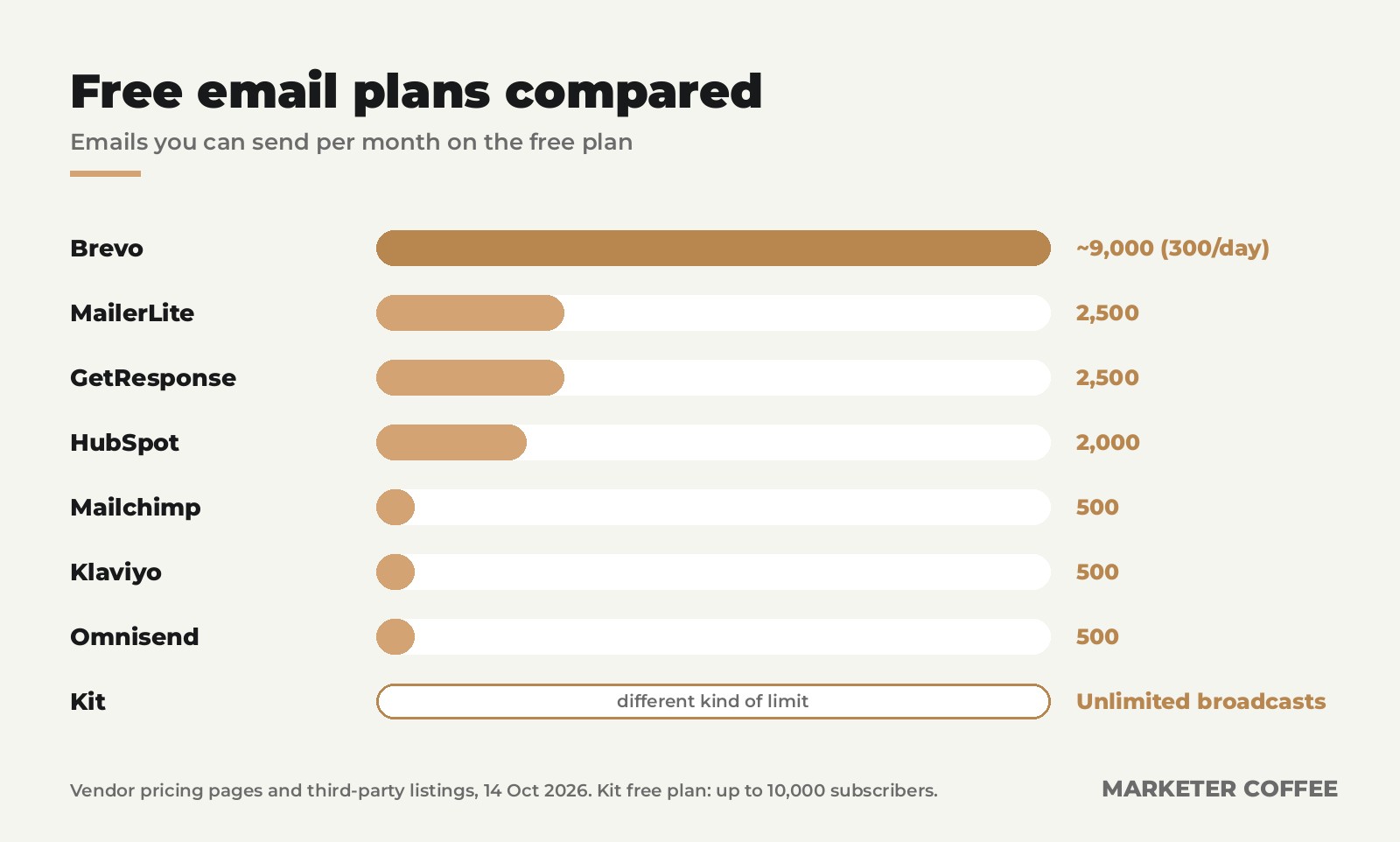
MailerLite and GetResponse allow 2,500 emails a month and HubSpot 2,000. Mailchimp, Klaviyo and Omnisend stop at 500, which is enough to test the tool and not much more. Free plans are a good way to learn an editor; they are rarely where a business should stay.
Is Klaviyo or Mailchimp Better?
Klaviyo is better for online stores that want email to drive orders, and Mailchimp is better for small businesses that need a general tool at a lower price.
Klaviyo’s advantage is data: it understands products, orders and customer value, and its flows and predictions are built around them. Mailchimp’s advantage is breadth and price at small sizes. If more than half of your email goals are about selling products from a store, Klaviyo pays for itself sooner. If email is mostly announcements, events and the occasional promotion, Mailchimp or MailerLite will cost less.
FAQ: Email Marketing Services
Short answers to the questions people ask most when choosing an email tool.
What is the best email marketing service overall?
Klaviyo is the best email marketing service for ecommerce brands, and MailerLite is the best overall value for small businesses. ActiveCampaign leads for automation in B2B and service companies.
What is the cheapest email marketing service?
Brevo is usually the cheapest for large lists because it charges per email sent, starting at about $9 a month. For contact-based plans, Omnisend starts at $11.20 a month and MailerLite at $12 a month.
Which email marketing service is best for Shopify?
Klaviyo is the best email marketing service for Shopify stores, thanks to its deep product and order data and pre-built ecommerce flows. Omnisend is a cheaper alternative with similar core automations.
Is GetResponse a Polish company?
Yes. GetResponse was founded in Gdańsk, Poland, in the late 1990s and still has its roots there. It serves customers worldwide and is known for combining email with webinars, courses and landing pages.
How much does email marketing software cost?
Most small businesses pay between $10 and $50 a month for up to 1,000 contacts. Costs rise with list size, and advanced platforms such as HubSpot Professional or Customer.io Premium cost hundreds or thousands of dollars a month.
Bring More People to the Store Your Emails Sell From
Email turns visitors into repeat customers, but it cannot create the first visit. Marketer Coffee is a Poland-based SEO agency that works with ecommerce and SaaS brands across the US, UK and Europe, at rates 40% to 60% below comparable US and UK agencies. We build the organic traffic that your email programme then converts. Every engagement starts with a free preliminary audit and a 90-day plan.
See scope and pricing in Ecommerce SEO Services, SaaS SEO Services and International SEO Services.
Written by Adrian Dąbrowiecki, founder of Marketer Coffee and SEO consultant with 7+ years in SaaS and ecommerce, specializing in topical authority and semantic SEO. Prices checked on each vendor’s pricing page on 14 October 2026. Where pricing pages did not display figures, third-party sources were used: TinyCommand on Klaviyo, Moosend on Brevo, Email Vendor Selection on ActiveCampaign, Style Factory on GetResponse and HubSpot’s blog. Ratings: G2. Statistics: Omnisend, 2026 Ecommerce Marketing Report; GroupMail on Mailchimp’s 2026 free plan. Screenshots belong to their respective vendors. No affiliate links.
Pingback: 8 Best Newsletter Platforms in 2026 (Free and Paid)