What does a meta description look like?
A meta description is a single meta tag with the name “description” and the summary in the content attribute, placed in the head next to the title tag:
- <meta name=”description” content=”Handmade leather wallets with free EU shipping. 14 colours, 2-year warranty, delivery in 2 to 4 days.”>
Google’s SEO Starter Guide describes a good meta description as a short summary of 1 or 2 sentences that is unique to the page and covers its most relevant points.
How does Google use the meta description?
Google uses the meta description as one possible source for the snippet, and only when it matches the query better than the page content. Google Search Central says snippets are generated automatically from page content and adapted to each query, so one page can show different snippets for different searches. That explains the rewrites: in the Ahrefs study published in 2020, Google showed the original meta description only about 37% of the time.
Is the meta description a ranking factor?
The meta description is not a Google ranking factor. Matt Cutts confirmed in 2009 that Google does not use the description meta tag for ranking, and John Mueller repeated this in 2020. It influences the click-through rate instead, because a clear, relevant snippet attracts more clicks from the SERP.
How long should a meta description be?
Google sets no official length limit for meta descriptions; it truncates snippets to fit the device width. In practice I aim for about 140 to 160 characters so the key message is visible on both mobile and desktop. Ahrefs found that length barely changes the odds of a rewrite: overlong descriptions were rewritten 61.46% of the time versus 63.69% for the rest.
How to write a good meta description
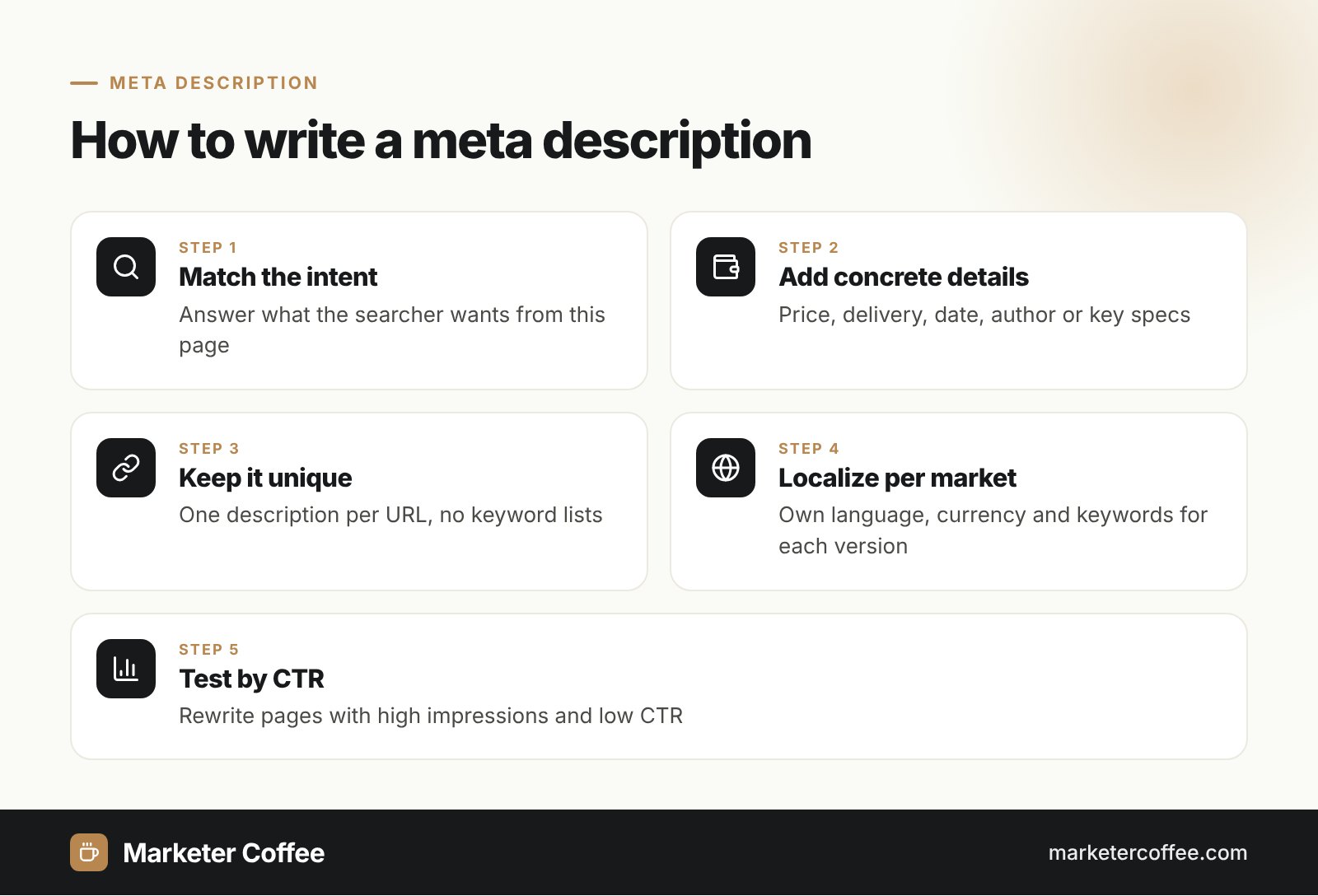
Write a meta description as a specific pitch that summarises the whole page. Google’s best practices and my own testing come down to 5 rules:
- Make it unique for every important URL, starting with the pages that bring revenue.
- Include concrete details: price, delivery time, author, date or key specifications.
- Answer the search intent behind the main keyword.
- Avoid keyword lists, which Google says are less likely to be shown.
- Generate descriptions from page data on large shops, keeping them readable and varied.
Snippet length can also be limited with the max-snippet robots directive, removed with nosnippet, or controlled for parts of the page with the data-nosnippet attribute.
Meta descriptions on multilingual sites
Meta descriptions on multilingual sites must be written for each market, not copied or machine-translated from the main language. A missing or untranslated description on the German version often leads Google to build a snippet from navigation or cookie banner text, or to show a description in the wrong language. On international projects I check 3 things:
- Language: every locale has a description in its own language, matching the hreflang target.
- Local details: currency, shipping country and local keywords, not the Polish or English ones.
- Uniqueness: country versions in the same language (de-DE and de-AT) differ where the offer differs.
Ahrefs found that 25.02% of top-ranking pages had no meta description at all, and in my audits of translated stores the share is often higher on secondary languages.
Meta descriptions and AI search
In AI search the meta description is a compact, brand-controlled summary that crawlers can read without parsing the whole page. It does not guarantee a citation in AI Overviews or ChatGPT, but a precise description that matches the content supports consistent understanding of the page, which is part of my AI SEO (GEO) checklist and the basics of on-page SEO.
Need descriptions that work in every market? See my international SEO consultancy.
Frequently asked questions about Meta description
Does the meta description affect SEO rankings?
No, Google has said since 2009 that it does not use the meta description for ranking. It still matters for SEO because it can shape the snippet and the click-through rate.
Why does Google change my meta description?
Google builds snippets automatically and uses your meta description only when it fits the query better than the page text. An Ahrefs study found Google rewrote about 63% of meta descriptions.
What is the ideal meta description length?
Google has no official limit and truncates snippets by device width. About 140 to 160 characters keeps the main message visible on most screens.
Do I need a meta description on every page?
Write unique descriptions for every important page, starting with the home page and pages that bring revenue. Large sites can generate descriptions from page data, as Google recommends.
Related terms
- Control your snippets in search results · Google Search Central
- SEO Starter Guide · Google Search Central
- How Often Does Google Rewrite Meta Descriptions? (New Data Study) · Ahrefs
- Are Meta Descriptions A Google Ranking Factor? · Search Engine Journal