



How does keyword cannibalization happen?
Keyword cannibalization happens when a site publishes several pages that answer the same question for the same user, and Google cannot tell which one deserves to rank. Typical causes are a blog post and a category page built around one phrase, yearly versions of the same article, filter and tag pages that duplicate a category, and landing pages created separately by SEO and PPC teams.
The signal is a URL that keeps changing for one query: in Search Console the position drops while a second page appears, then the first page returns. Links, internal anchors and clicks are split between the URLs, so neither page reaches the position one strong page would get.
Is keyword cannibalization always a problem?
Keyword cannibalization is a problem only when pages share the same intent. Two pages ranking for one phrase can be fine if they serve different needs, for example a “running shoes” category and a “how to choose running shoes” guide. Asked in September 2025 about pages competing in Search Console, Mueller said 3 pages from one site in a result are not worrying in themselves and advised removing unnecessary duplication. I treat it the same way in audits: overlap is a symptom to check, not a fault to fix by default.
How to find keyword cannibalization
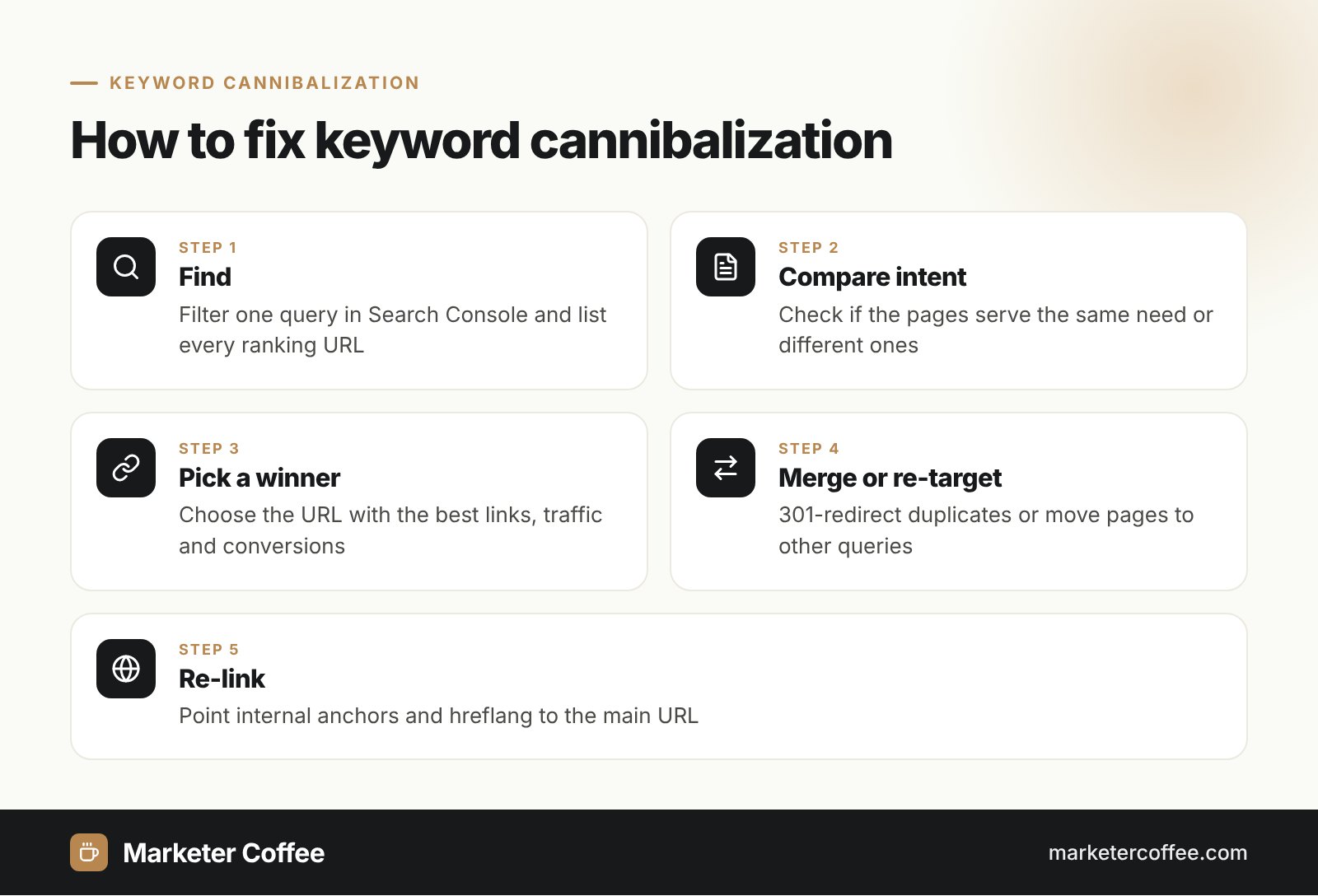
Finding cannibalization takes query-level data from Search Console plus a check of search intent:
- Open the Performance report, filter one query and switch to the Pages tab.
- Note every URL with impressions for that query and its average position.
- Compare dates: alternating URLs over weeks point to cannibalization.
- Check the live SERP to see which intent Google rewards.
- Confirm with a site: search or a crawl that lists duplicate titles and H1s.
How to fix keyword cannibalization
The fix depends on whether the competing pages should exist at all. The table shows the 4 main options.
| Fix | When to use it | Effect |
|---|---|---|
| Merge and 301 redirect | Pages share intent and the weaker one has no own purpose | Signals move to one URL |
| Canonical tag | Near-duplicates must stay live (filters, print versions) | Google indexes the preferred URL |
| Re-target | Both pages are useful but for different intents | Each page gets its own query set |
| Fix internal linking | The wrong page gets the anchors | Anchors point to the main page |
Google Search Central calls a redirect and rel=”canonical” strong canonicalization signals and sitemap inclusion a weak one. For a merged article I use a 301 redirect, because the old URL has no reason to stay indexed.
Keyword cannibalization on multilingual sites
On international sites cannibalization usually appears between language or country versions in the same language, for example de-DE and de-AT pages, or an English global page outranking the UK version. The fix is not merging but hreflang with return links and a self-referencing canonical on each version, so Google swaps the right URL per market instead of choosing one. Google Search Central recommends picking a preferred version for same-language content on different regional URLs and marking the alternates with hreflang. I also check Search Console per country: a German query showing the Polish page usually means a missing hreflang link, not a content problem.
Need a cannibalization check across markets? It is part of every SEO audit I run and of my international SEO consultancy.
Frequently asked questions about Keyword cannibalization
What is an example of keyword cannibalization?
A shop has a category page for running shoes and a blog post titled best running shoes, both aimed at buyers ready to purchase. Google alternates between them for the same query, and neither ranks as high as one combined page would.
Does Google penalise keyword cannibalization?
No, there is no penalty for keyword cannibalization. The cost is indirect: links, anchors and clicks are split between pages, so the best page ranks lower than it could.
How do I check keyword cannibalization in Search Console?
Open the Performance report, filter one query and switch to the Pages tab. Several URLs with impressions that alternate over time point to cannibalization.
Can language versions cannibalize each other?
Yes, versions in the same language for different countries, such as de-DE and de-AT, often compete. Hreflang with return links and self-referencing canonicals tells Google which version to show in each market.
Related terms
- Google Answers SEO Question About Keyword Cannibalization · Search Engine Journal
- How to specify a canonical URL with rel="canonical" and other methods · Google Search Central
- Performance report (Search results) · Google Search Console Help
- Google Search won't show more than two top results from the same site · Engadget
- Managing multi-regional and multilingual sites · Google Search Central
