What does an ideal customer profile include?
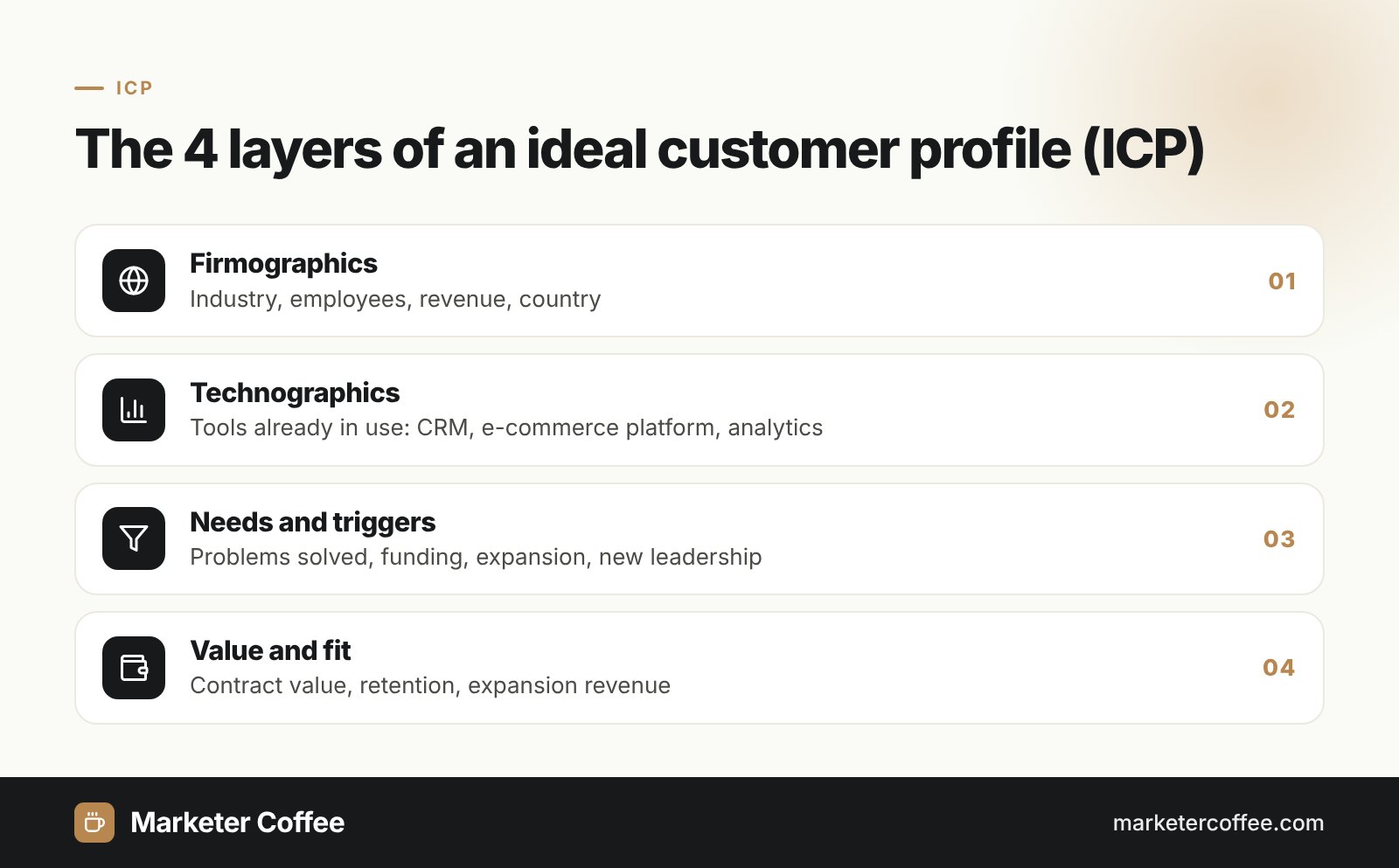
An ICP includes the company-level attributes shared by your best customers. Clearbit, now part of HubSpot, describes it as a set of firmographic and technographic traits of the accounts most likely to benefit from your offer. A complete ICP has four layers:
Firmographics
Firmographics describe the company itself: industry, number of employees, revenue, funding stage and headquarters country. Example: “SaaS companies with 50 to 500 employees in the DACH region”.
Technographics
Technographics list the tools a company already uses, such as Shopify, Salesforce or HubSpot CRM. A shared tech stack often means an easier integration and a shorter sales cycle.
Needs and triggers
This layer covers the problem your product solves and the events that start a purchase, such as a funding round, expansion into a new country or a new head of marketing. Gartner notes that 99% of B2B purchases are driven by organisational change.
Value and fit signals
The last layer records what makes an account profitable: average contract value, retention, expansion revenue and support cost. Compare these numbers across your current customers to see which segment really deserves the “ideal” label.
ICP vs buyer persona
An ICP describes which companies to target, while a buyer persona describes which people inside those companies to persuade.
| Ideal customer profile (ICP) | Buyer persona | |
|---|---|---|
| Unit | Company (account) | Person (role) |
| Data | Industry, size, revenue, tech stack | Goals, pains, objections, channels |
| Main users | Sales, RevOps, ABM teams | Content, product marketing |
| Example | B2B SaaS, 50 to 500 staff, Germany | Head of Marketing who reports pipeline |
How to build an ICP in 5 steps
- Export your current customers with revenue, retention and acquisition cost.
- Rank them by lifetime value and pick the top 20%.
- Find the attributes they share across firmographics and technographics.
- Validate the pattern with sales calls and lost-deal reasons.
- Score every new lead against the ICP and review the profile every 6 to 12 months.
ICP in SEO, content and AI search
An ICP shapes SEO because it tells you which keywords, markets and questions are worth winning. When I build a B2B SaaS SEO strategy, the ICP decides which countries get localised pages first and which problem-level queries deserve content. A keyword with 50 searches a month from your ICP is worth more than one with 5,000 from students.
The ICP also matters for AI search. Buyers increasingly ask ChatGPT or Perplexity for vendor shortlists, and Gartner found that 45% of B2B buyers used AI during a recent purchase. Content that names your ICP’s industry, size and use case in plain words helps AI engines match your brand to those prompts, which is the goal of GEO.
Finally, Professor John Dawes of the Ehrenberg-Bass Institute estimates that only about 5% of B2B buyers are in market at any time. A clear ICP lets you build brand awareness among the other 95% before they start looking. Track progress with ICP-specific KPIs such as pipeline from ICP accounts.
If you sell B2B and want SEO that brings ICP accounts rather than random traffic, see my B2B SEO services.
Frequently asked questions about ICP
What does ICP stand for in marketing?
ICP stands for ideal customer profile. It describes the type of company that gets the most value from your product and is most valuable to you.
What is the difference between ICP and buyer persona?
An ICP describes target companies by attributes such as industry, size and tech stack. A buyer persona describes individual decision makers inside those companies, with their goals and objections.
Is ICP only for B2B?
The ICP is mainly a B2B concept because it describes companies, not consumers. B2C brands usually work with customer segments and personas instead.
How often should you update your ICP?
Review your ICP every 6 to 12 months or after a major change such as a new product or market. Base the update on real revenue and retention data from your customers.
Related terms
- Finding your Ideal Customer Profile (ICP): Introduction · Clearbit (HubSpot)
- Gartner Sales Survey Finds 67% of B2B Buyers Prefer a Rep-Free Experience · Gartner
- The B2B Buying Journey · Gartner
- The 95:5 Rule: Why B2B Growth Starts Long Before the Purchase · Ehrenberg-Bass Institute