What is a chatbot?
A chatbot is an interface that replaces forms, menus or a human agent with a dialogue. The user types or says something, the bot interprets the message and replies, then waits for the next turn. Chatbots live on websites, in messaging apps such as Messenger and WhatsApp, in mobile apps, in voice assistants and inside search engines. Businesses use them for customer service, lead qualification, booking and product recommendations.
How does a chatbot work?
A chatbot works in a loop of input, understanding, response generation and output. What changes between bot types is the middle part:
- Rule-based bots match keywords or button clicks to scripted answers.
- NLP bots classify the user’s intent and extract entities such as dates or product names, then pick a prepared answer.
- LLM bots generate a new answer word by word with a large language model, often grounded in company documents or live web results (retrieval-augmented generation).
ELIZA from 1966 used the first approach: according to MIT CSAIL, it relied on pattern matching and substitution to turn the user’s sentences into follow-up questions, imitating a Rogerian psychotherapist.
Types of chatbots
Chatbots fall into 3 main types, which differ in flexibility, cost and risk.
Rule-based chatbots
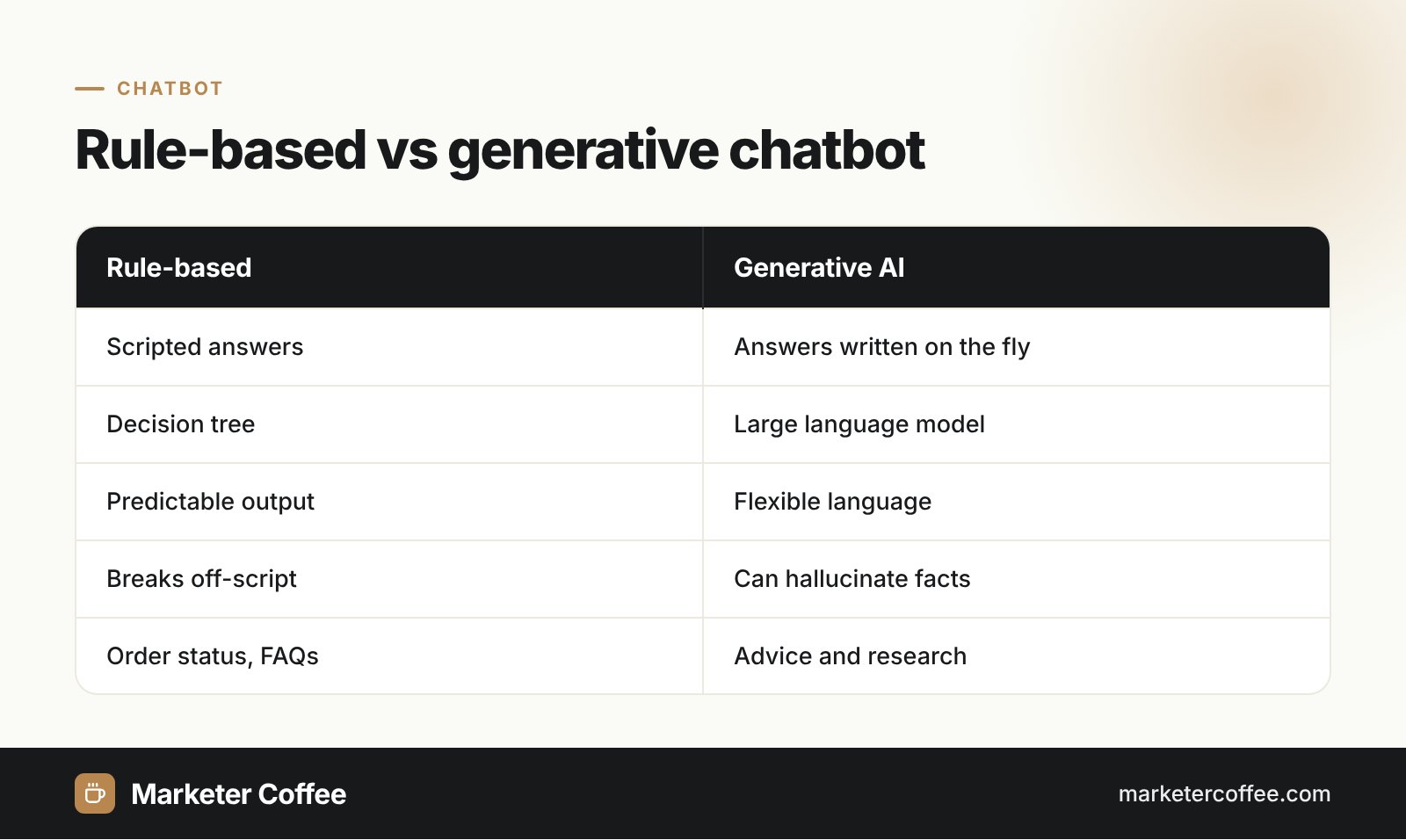
Rule-based chatbots follow a decision tree written by a person. They are cheap, predictable and good for order tracking or opening hours, but fail as soon as the user leaves the script.
AI chatbots with NLP
Intent-based AI chatbots understand varied phrasing but still answer from a fixed library. Many customer service platforms from the late 2010s work this way.
Generative AI chatbots
Generative chatbots such as ChatGPT, Google Gemini and Perplexity AI write original answers and handle open questions. They need guardrails, because a language model can produce confident but wrong statements.
Chatbot milestones
| Year | Milestone |
|---|---|
| 1966 | ELIZA created by Joseph Weizenbaum at MIT |
| 2016 | Facebook opens the Messenger bot platform to businesses |
| 2022 | Gartner: 54% of surveyed organisations use some form of chatbot or conversational AI |
| 2025 | ChatGPT reaches 800 million weekly active users (OpenAI DevDay, 6 October) |
Chatbots in marketing, SEO and AI search
Chatbots matter to marketers in two ways: as a channel you run on your own site and as a channel where customers now research your brand. On your site, a bot answers pre-sales questions at night, qualifies a lead before a sales call and reduces support tickets. Gartner predicted in July 2022 that by 2027 roughly a quarter of organisations would use chatbots as their primary customer service channel.
The second role is bigger for SEO. Generative chatbots answer product questions directly and cite only a few sources, so your brand either appears in that answer or does not exist for that user. This is why I connect chatbot visibility with AI SEO (GEO) services and with entity SEO: the bot has to recognise your brand as an entity and find clear, quotable facts about it.
How to implement a chatbot on your website
Implementing a chatbot starts with a narrow job, not with picking software. These steps keep the project measurable:
- Choose one job, for example answering delivery questions or booking demos.
- Collect the most frequent questions from email, phone and live chat.
- Connect the bot to a single, up-to-date knowledge base or product feed.
- Define a handover to a human for complaints, refunds and sales-ready leads.
- Track resolution rate, handover rate and the conversion rate of chat users.
Rule-based vs generative chatbot
| Criterion | Rule-based | Generative AI |
|---|---|---|
| Answers | Pre-written | Generated on the fly |
| Setup | Decision trees | Prompts, knowledge base, guardrails |
| Risk | Dead ends | Hallucinated facts |
| Best for | Order status, FAQs | Advice, research, complex questions |
Frequently asked questions about Chatbot
What was the first chatbot?
The first chatbot was ELIZA, created by Joseph Weizenbaum at MIT in 1966. It used pattern matching to rephrase the user's statements as questions, imitating a psychotherapist.
What is the difference between a chatbot and ChatGPT?
ChatGPT is one example of a chatbot, specifically a generative AI chatbot built on OpenAI's large language models. Many other chatbots are rule-based and only answer from a fixed script.
Are chatbots good for SEO?
A website chatbot does not raise rankings directly, but its logs reveal real customer questions you can turn into content. Generative chatbots also act as a search channel, so being cited in their answers is now part of SEO.
Related terms
- ELIZA, the first chatbot (MIT CSAIL) · MIT CSAIL
- Gartner Predicts Chatbots Will Become a Primary Customer Service Channel Within Five Years · Gartner
- Sam Altman says ChatGPT has hit 800M weekly active users · TechCrunch
- ChatGPT: popularność w Polsce w 2025 roku (dane Gemius/PBI) · Antyweb
- Facebook Messenger · Wikipedia