



What is Google Keyword Planner?
Google Keyword Planner is a free research tool inside Google Ads that suggests keywords and estimates their search volume, competition and cost. Google built it for planning Search campaigns, but SEO specialists use it as a first-party source of Google search demand. To open it, you need a Google Ads account with completed setup, including billing details, though you do not have to run ads.
How does Google Keyword Planner work?
Keyword Planner works through two entry points: “Discover new keywords” and “Get search volume and forecasts”. In the first, you enter seed words, a website URL or both, and the tool returns related ideas you can filter by competition, category or brand. In the second, you paste or upload a list (keywords up to 80 characters and 10 words each) and receive historical data plus a spend-based forecast.
Which metrics does Keyword Planner show?
Keyword Planner shows six historical metrics per keyword, each defined in Google Ads Help:
| Metric | What it means |
|---|---|
| Avg. monthly searches | Average searches for the keyword and close variants, 12 months by default |
| Competition | Low, medium or high advertiser density compared with all keywords |
| Top of page bid (low range) | About the 20th percentile of top-of-page bids paid |
| Top of page bid (high range) | About the 80th percentile of top-of-page bids paid |
| Organic impression share | Share of searches where your site appeared organically |
| Ad impression share | Your ad impressions divided by total exact-match searches |
Two details matter: historical metrics reflect exact-match searches regardless of match type, and volumes are rounded, so totals across locations may not add up. Forecasts refresh daily using the last 7 to 10 days of data adjusted for seasonality.
History of Google Keyword Planner
Keyword Planner replaced the AdWords Keyword Tool and Traffic Estimator, which Google merged into one tool in 2013. In August 2016 Google began showing only volume bands to low-spending accounts, which pushed many SEO teams towards paid tools. The tool now lives in Google Ads under Tools, in the Planning section.
How to use Keyword Planner for SEO
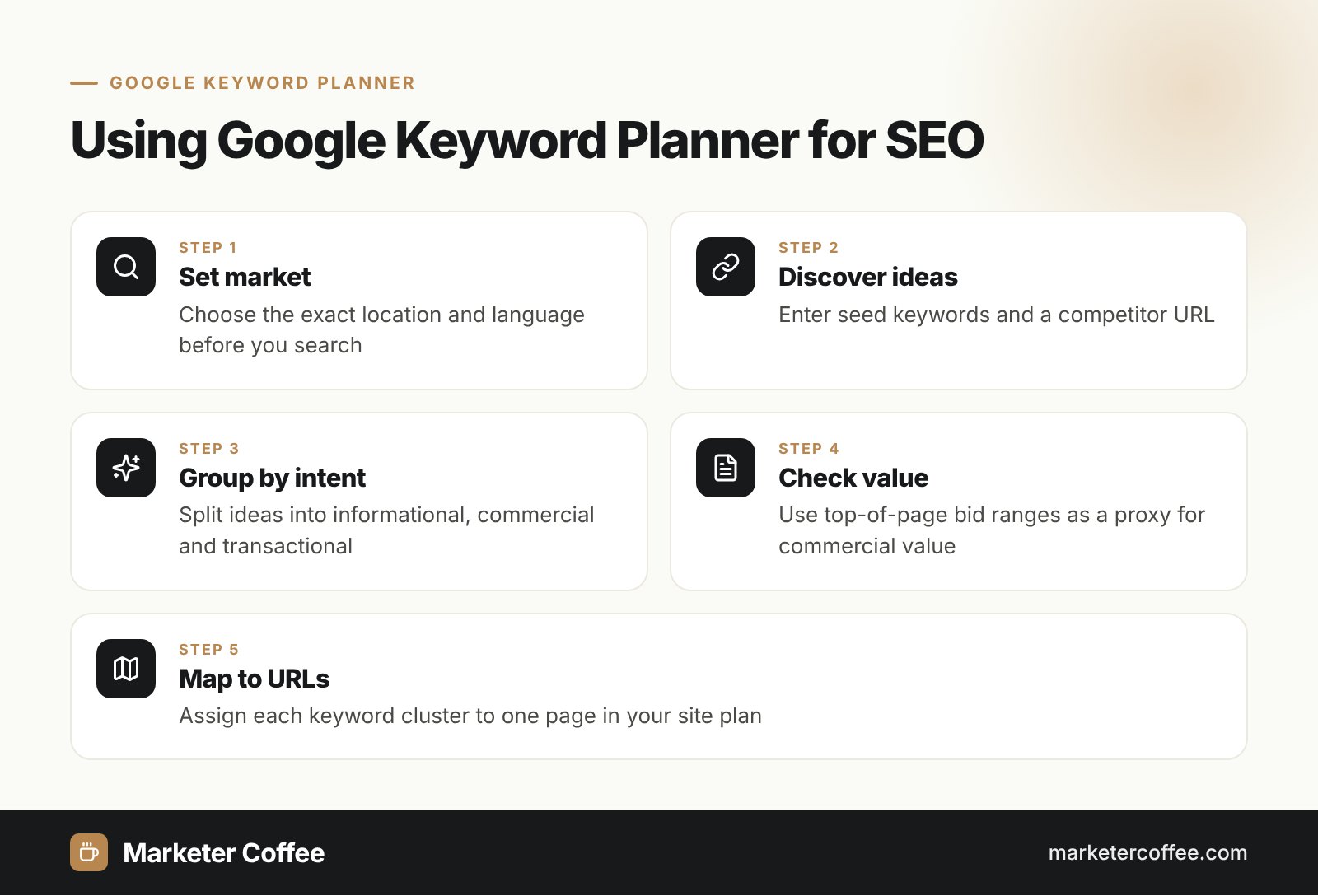
Keyword Planner is useful for SEO as a source of Google’s own demand data per country and language, which third-party tools only estimate. I use it in five steps:
- Set the exact location and language, for example Germany and German.
- Enter seed terms and a competitor URL in “Discover new keywords”.
- Group ideas by intent: informational, commercial and transactional.
- Read the top-of-page bid as a proxy for commercial value and likely conversion potential.
- Map each cluster to one URL in your SEO strategy.
For international projects I pull volumes separately for each market, because a direct translation of a Polish keyword often has a different volume or intent abroad. Pair the data with CTR expectations and AI Overviews presence, since a high-volume query answered by AI may send fewer clicks.
Keyword Planner vs third-party SEO tools
Keyword Planner wins on data source and cost, while tools like Ahrefs, Semrush or Surfer SEO win on organic difficulty and SERP analysis.
| Aspect | Keyword Planner | Third-party SEO tools |
|---|---|---|
| Data source | Google Ads data | Clickstream and modelled estimates |
| Price | Free with a Google Ads account | Paid subscriptions |
| Organic difficulty | Not available | Available |
| Cost per click data | Bid ranges from real auctions | Estimated CPC |
Frequently asked questions about Google Keyword Planner
Is Google Keyword Planner free?
Yes, Keyword Planner is free, but it requires a Google Ads account with completed setup and billing details. You do not have to run an active campaign to use it.
Why does Keyword Planner show ranges instead of exact volumes?
Google confirmed in 2016 that accounts with little or no ad spend see broad volume bands, such as 1K to 10K, instead of exact averages. Running an active campaign usually unlocks more precise numbers.
Is Keyword Planner good for SEO?
Yes, it is a good source of Google's own search demand by country and language. It lacks organic difficulty and SERP data, so pair it with an SEO tool.
What does top of page bid mean?
It is the bid range advertisers historically paid to appear at the top of results. The low range approximates the 20th percentile and the high range the 80th percentile.
Related terms
- Use Keyword Planner · Google Ads Help
- About Keyword Planner forecasts and historical metrics · Google Ads Help
- Google officially throttling Keyword Planner data for low spending AdWords accounts · Search Engine Land
- Keyword Planner replaces Keyword Tool: changes explained · Engage Web
