What is Asana?
Asana is a cloud-based work management platform where teams plan projects, assign tasks, set deadlines and track goals in one place. It is built by Asana, Inc., headquartered in San Francisco and listed on the New York Stock Exchange under the ticker ASAN. Marketing teams use it to run content calendars, campaign launches and creative approvals.
History of Asana
Asana was founded in 2008 by Facebook co-founder Dustin Moskovitz and former Facebook engineer Justin Rosenstein, who wanted to cut the time teams spend on “work about work”.
| Year | Milestone |
|---|---|
| 2008 | Company founded by Dustin Moskovitz and Justin Rosenstein |
| 2012 | Commercial launch and public API |
| 2020 | Direct listing on the NYSE (ticker ASAN) |
| 2023 | Warsaw office opened, the first in the EMEA region per the announcement |
| 2024 | AI Studio launched for no-code AI workflows |
| 2025 | Dan Rogers becomes CEO; Moskovitz stays as chair |
In fiscal year 2026, which ended on 31 January 2026, Asana reported revenue of $790.8 million, up 9% year over year, with 25,928 core customers spending at least $5,000 a year and 817 customers spending over $100,000.
Key features of Asana
Asana combines project views, automation and AI on top of a shared “work graph” that links tasks, projects and goals.
Project views
Asana shows the same work as a list, Kanban board, timeline (Gantt), calendar or workload view, so each team member picks the format that suits them.
Rules and automation
Rules move tasks, assign owners and notify people automatically when a trigger occurs, for example when a form is submitted.
Goals and reporting
Goals connect daily tasks to company objectives and KPIs, with dashboards showing progress.
AI Studio and AI Teammates
AI Studio lets teams build AI-powered workflows without code, and AI Teammates act as agents that take on tasks. AI Studio credits are included in paid plans from Starter upwards.
Asana in marketing and SEO teams
Asana helps marketing teams by turning recurring work into repeatable templates. In SEO projects I use a structure like this: one project per market, sections for technical fixes, content and links, and a form for content briefs that automatically creates tasks for writers and editors. Integrations with Slack, Google Workspace and Figma keep briefs, designs and discussions linked to the task.
- Plan editorial calendars with timeline and calendar views.
- Track technical SEO fixes with priority and status fields.
- Collect requests through forms instead of email threads.
- Report progress to clients with dashboards tied to goals.
A clear process makes a long-term SEO strategy actually happen, month after month.
Asana plans and pricing tiers
Asana offers five plans: Personal, Starter, Advanced, Enterprise and Enterprise+. The free Personal plan covers up to 2 users, which is enough for a freelancer working with one client. Paid plans add timelines, automation, reporting and monthly AI Studio credits: 50,000 on Starter, 75,000 on Advanced and 200,000 on Enterprise tiers, per billing account, according to Asana’s pricing page.
| Plan | Who it suits | AI Studio credits per month |
|---|---|---|
| Personal | Individuals and pairs (up to 2 users) | Not included |
| Starter | Small teams starting with projects | 50,000 |
| Advanced | Teams managing portfolios and goals | 75,000 |
| Enterprise / Enterprise+ | Large organisations with security needs | 200,000 |
Asana vs Trello vs ClickUp
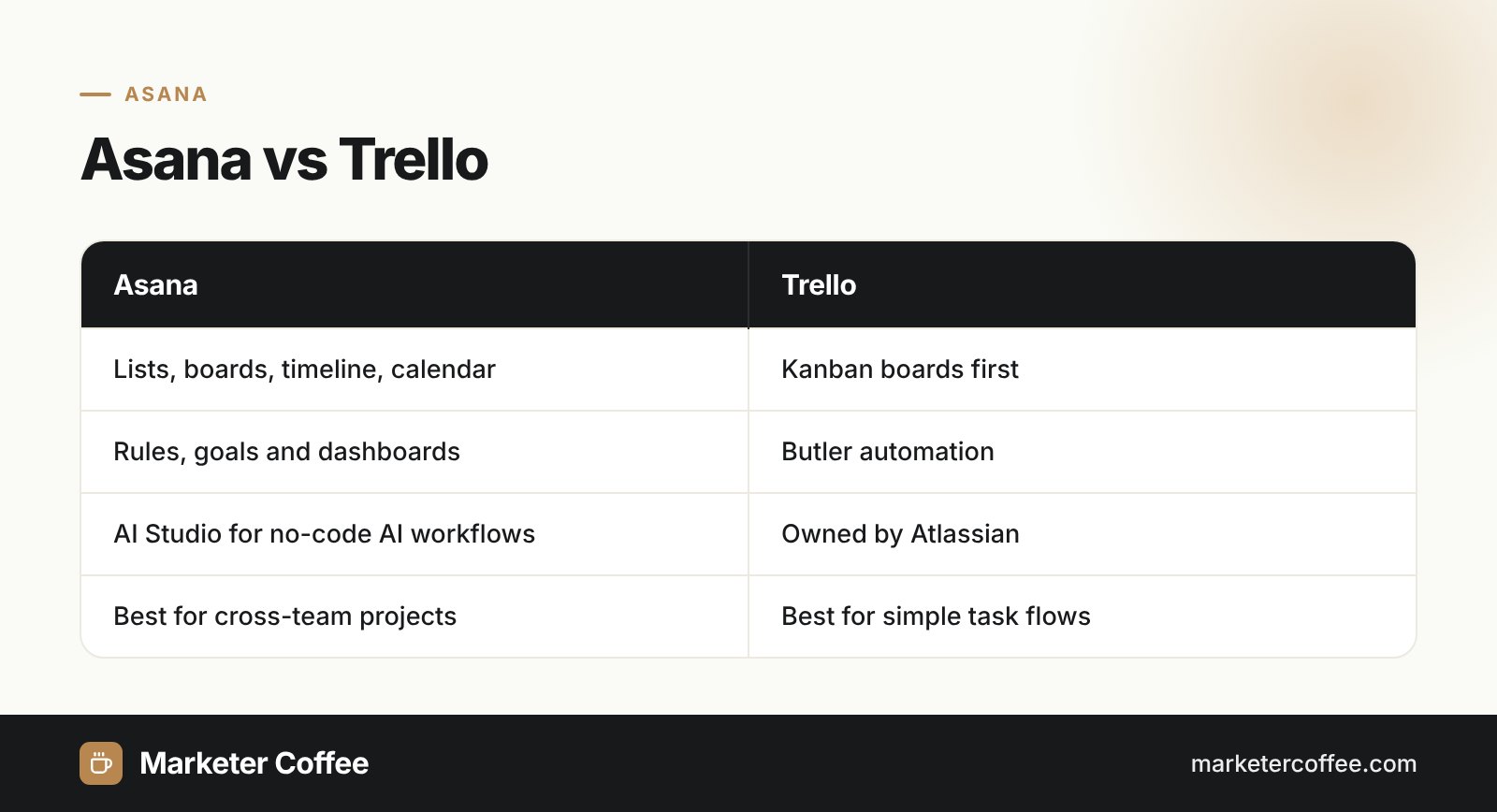
Asana sits between Trello’s simplicity and ClickUp’s all-in-one breadth.
| Aspect | Asana | Trello | ClickUp |
|---|---|---|---|
| Best for | Cross-team projects and goals | Simple Kanban boards | Teams wanting one tool for everything |
| Owner | Asana, Inc. (NYSE: ASAN) | Atlassian | ClickUp (private) |
| Learning curve | Moderate | Low | Higher |
Frequently asked questions about Asana
Who founded Asana?
Asana was founded in 2008 by Dustin Moskovitz, a co-founder of Facebook, and Justin Rosenstein, a former Facebook engineer. Dan Rogers has been CEO since July 2025.
Is Asana free?
Yes, Asana has a free Personal plan for up to 2 users. Paid plans (Starter, Advanced, Enterprise and Enterprise+) add features such as timelines, automation and AI Studio credits.
What is Asana used for?
Asana is used to plan projects, manage tasks, automate workflows and track goals. Marketing teams use it for content calendars, campaign launches and approvals.
What is Asana AI Studio?
AI Studio is Asana's no-code tool for building AI-powered workflows, launched in 2024. Paid plans include monthly AI Studio credits.
Related terms
- Asana Announces Fourth Quarter and Fiscal Year 2026 Results · Asana Investor Relations
- Asana, Inc. · Wikipedia
- Asana Opens New Office in Warsaw, Poland · Asana
- Asana pricing · Asana
- Asana is available in Traditional Chinese, Russian, Dutch, and Polish · Asana