
The biggest SEO trends of 2026 are that AI answers now sit between searchers and websites, fewer searches send any click at all, being cited by AI has become a separate goal from ranking, and AI agents have started using websites on people’s behalf. I am Adrian Dąbrowiecki, an SEO consultant who has worked with SaaS and ecommerce brands for more than seven years, and this guide covers what actually changed in search between January and October 2026, with sources for every number, and what I would do about each change.
Most “SEO trends” articles are written in January and guess. This one is written in October, so it can look back at what happened: two Google core updates, four spam updates, AI Mode passing a billion monthly users, the first Search Console report for AI features, and a measurable drop in clicks. Some long-predicted trends turned out to be real. Others did not move much.
What Are the Biggest SEO Trends in 2026?
The biggest SEO trends in 2026 are the growth of AI Overviews and AI Mode, a rising share of zero-click searches, the move from ranking to being cited in AI answers, new reporting for AI traffic, and the first standards for AI agents that act on websites.
What ties them together is that Google is no longer the only place where search happens, and even inside Google, the results page is increasingly an answer rather than a list. Classic SEO work, crawlable pages, useful content, links and a clear site structure, still decides whether you get into those answers. What has changed is what you measure and what counts as a win.
Below are the changes I think matter most, each with what the data says and what I would do about it. If you need the fundamentals first, start with How to create an SEO strategy that works in 2026.
How Big Are AI Overviews and AI Mode Now?
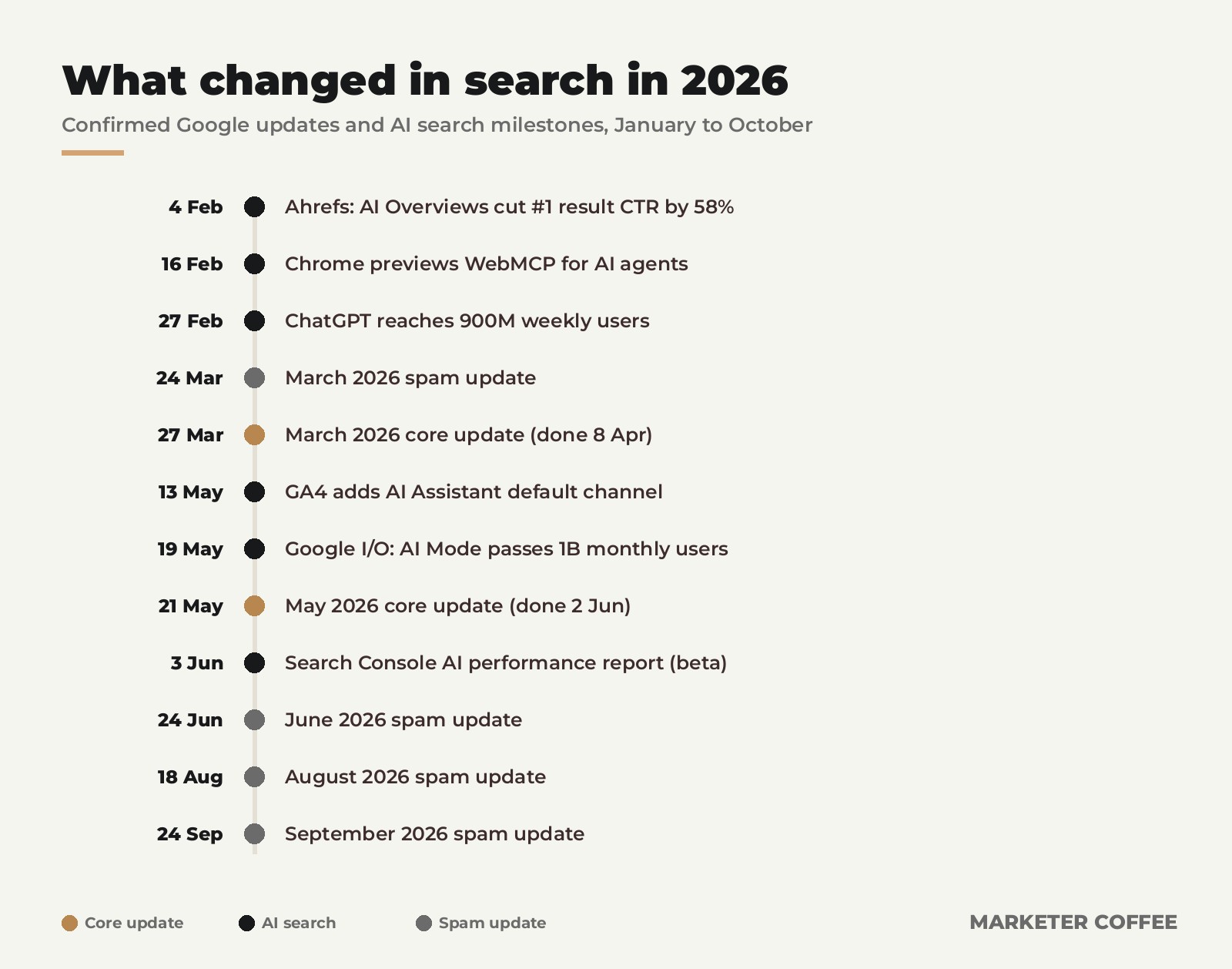
AI Overviews reach about 2.5 billion monthly users and AI Mode passed one billion monthly users within its first year, according to figures Google shared around its I/O conference in May 2026.
AI Mode is the full conversational version of Google Search, and at I/O on 19 May Google said its query volume had more than doubled every quarter since launch. Gemini 3.5 Flash became the default model in AI Mode, the search box was redesigned for longer questions with images, files and Chrome tabs, and Google announced information agents that monitor the web for changes on a user’s behalf, starting with paid AI Pro and Ultra subscribers.
For site owners, the practical point is that a growing share of Google searches now ends in an answer that may or may not cite you. A page can rank in the top three and still be invisible in the AI summary above it. The reverse is also true, as the next section shows.
Do You Still Need to Rank in the Top 10 to Appear in AI Overviews?
No. Ahrefs found in March 2026 that only 38% of pages cited in AI Overviews also rank in the top ten organic results for the same query, down from about 76% in its July 2025 study.
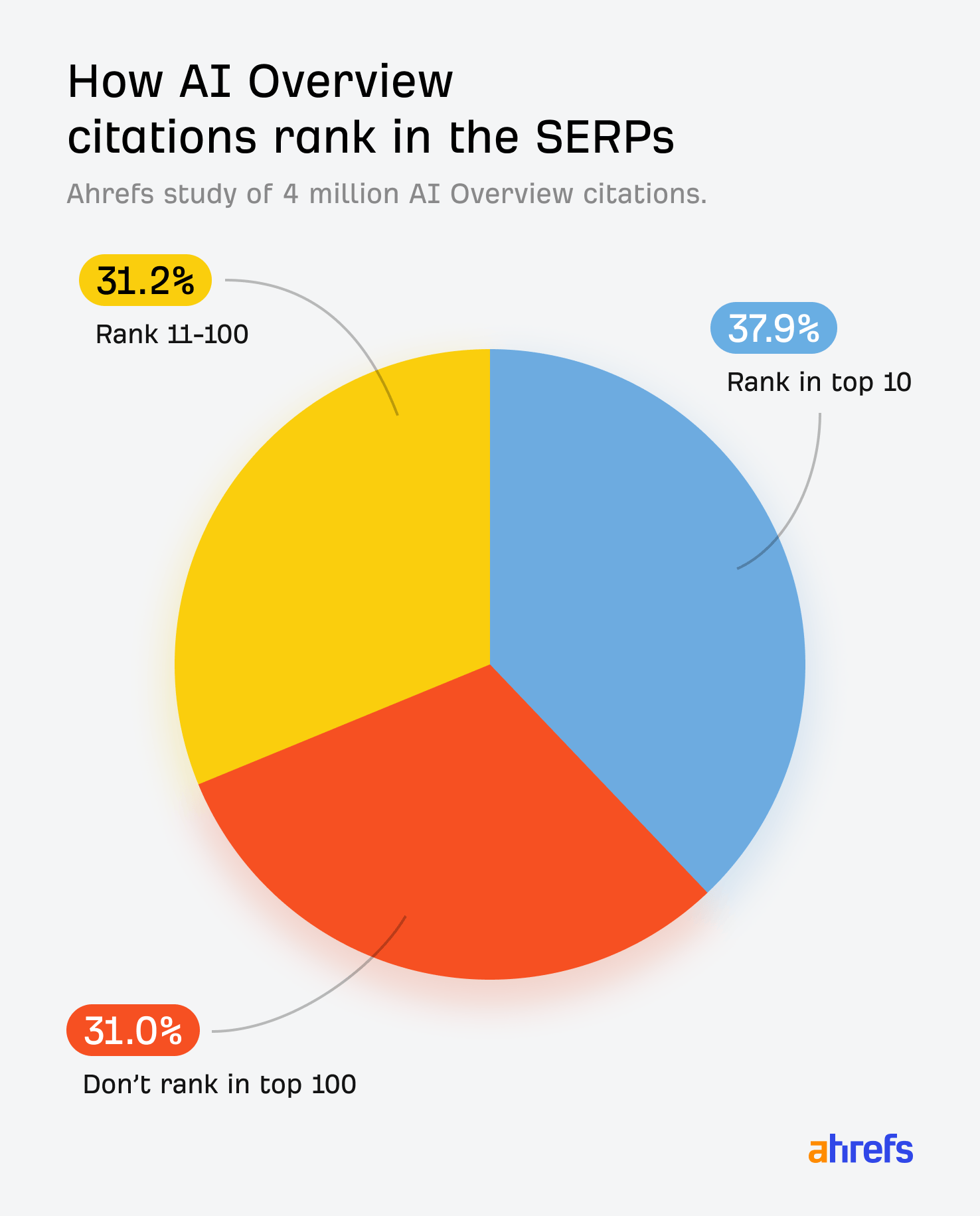
The study covered 863,000 keyword results pages and 4 million cited URLs. Ahrefs notes that its citation detection improved between the two studies, so part of the change is method, not behaviour. Even so, nearly 37% of cited pages did not rank in the top 100 at all. The most likely explanation is query fan-out: AI Mode and AI Overviews break a question into several related searches and cite pages that answer the sub-questions, not only the original query.
What I would do about it: write pages that answer the follow-up questions in a topic, not just the head term, and make each answer self-contained enough to be quoted. That is what topical authority has always meant, and it is now visible in the citations. I cover the mechanics in LLM SEO.
How Many Google Searches End Without a Click in 2026?
About 68% of US Google searches ended without a click in January to April 2026, according to SparkToro’s analysis of Similarweb clickstream data, up from 60.45% in 2024.
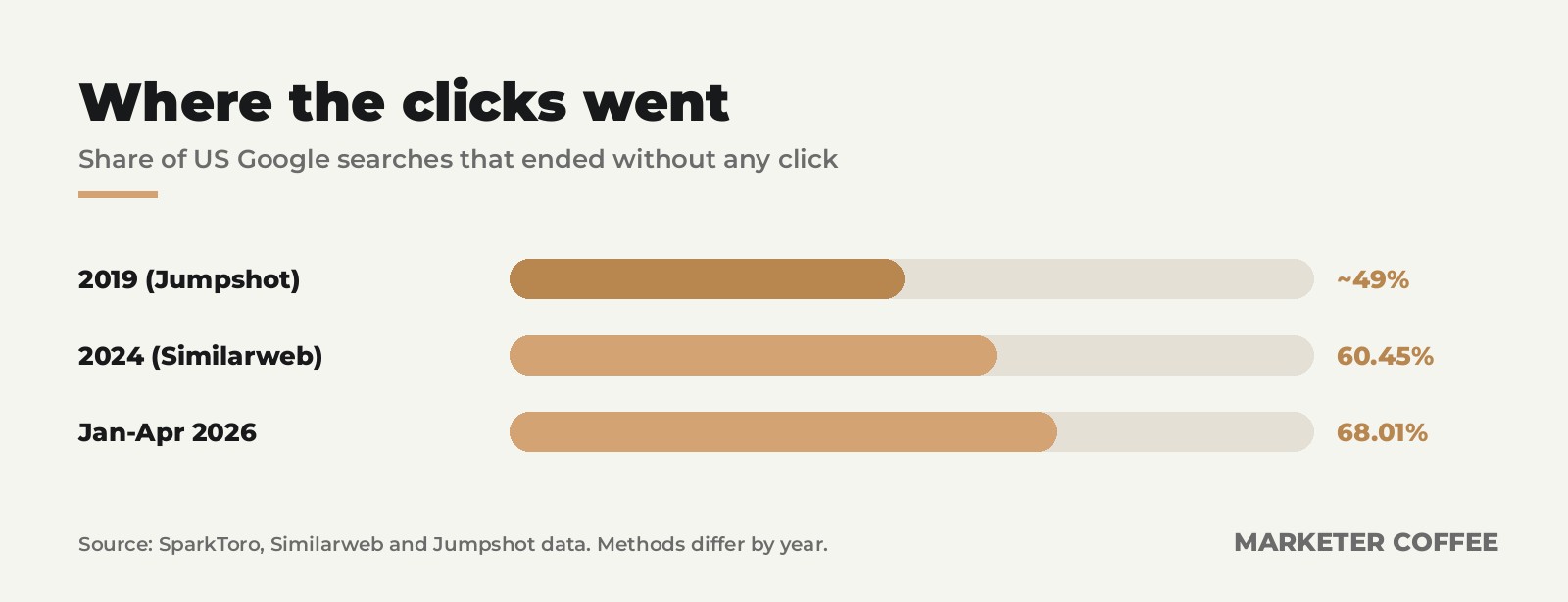
The same analysis found that searches leading to another Google search rose by about seven percentage points, which suggests people refine and follow up inside Google more than before. The study excludes Google’s mobile app, where zero-click behaviour is probably higher, and the 2019 comparison point came from a different data provider, so treat the long-term trend as direction rather than precision.
AI Overviews are a large part of the story. Ahrefs’ February 2026 study of 300,000 keywords found that when an AI Overview appears, the top-ranking page gets 58% fewer clicks than it would be expected to without one. Pew Research found a similar pattern from real browsing data in 2025: people clicked a traditional result on 8% of visits to pages with an AI summary and on 15% without one, and clicked a link inside the summary only 1% of the time.
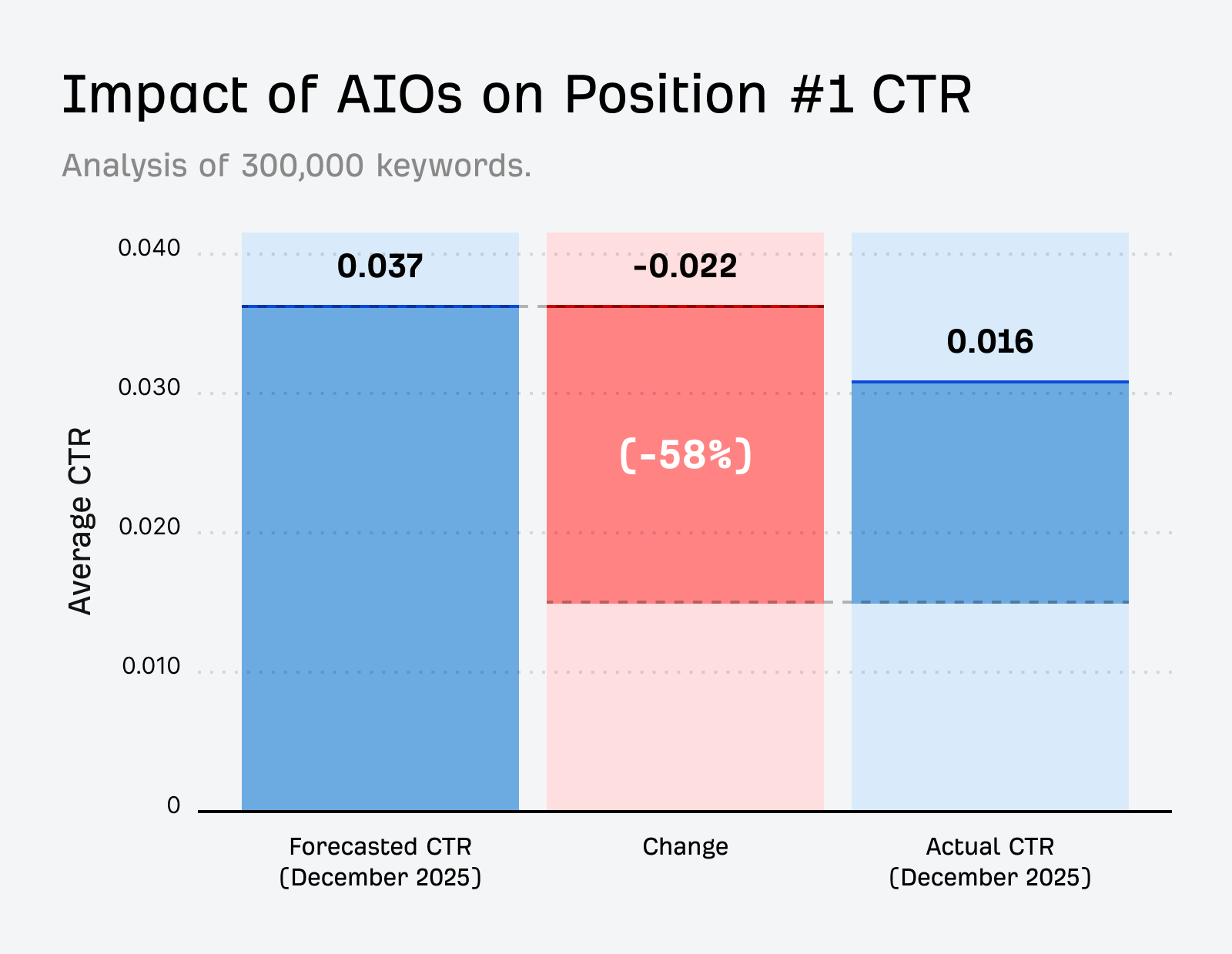
What I would do about it: stop reporting SEO on clicks alone. Track impressions, branded search growth and conversions from organic traffic, and accept that informational keywords now work more like brand exposure than traffic. Commercial and transactional pages, where people still need to visit a site to act, are where clicks hold up best.
What Did the 2026 Google Core Updates Change?
Google released two broad core updates in 2026, in March and May, plus four spam updates, and neither core update came with a specific new rule; both were described as regular updates to surface “relevant, satisfying content”.
The March 2026 core update ran from 27 March to 8 April and followed the March spam update by a few days. The May 2026 core update ran from 21 May to 2 June, and Search Engine Roundtable’s coverage described it as the larger of the two, with volatility spiking again near the end. Spam updates followed in June, August and September; the September one started on 24 September. Google also ran a separate Discover core update in February.
My reading of the pattern is the same as in 2024 and 2025. Sites that lost visibility tended to have thin pages built for keywords rather than people, aggressive programmatic content or a mismatch between what a page promises and what it delivers. Sites that gained tended to show first-hand expertise and clear authorship. There is no fix to apply after a core update; there is only better content and a cleaner site, assessed over months. If an update hurt you, the competitor analysis process is the fastest way to see what the winners did differently.
Can You Measure AI Search Traffic Now?
Partly. Since June 2026 Search Console has a beta report for impressions in AI Overviews and AI Mode, and since May GA4 groups visits from ChatGPT, Gemini and Claude into an AI Assistant channel, but neither shows the full picture.
The Search Console report launched on 3 June 2026 for a subset of sites, first in the UK, and shows impressions by page, country, device and date. It does not show clicks, click-through rate, position or the queries that triggered the AI answer, and Google says more metrics will come. Clicks from AI Mode still appear in the normal Performance report, mixed with classic results.
GA4’s AI Assistant channel, added on 13 May, is the simplest way to see referral traffic from chatbots, and Microsoft Clarity now shows which AI crawlers visit your pages and whether those visits turn into real referrals. Mentions without a link, which is most of how AI assistants talk about brands, still need a separate AI visibility tracker. I compare those in the best AI visibility tools, and the wider measurement setup is in Measuring SEO: How to track SEO results?
Is ChatGPT Replacing Google Search?
Not yet in volume, but it has become a second search channel that no serious brand can ignore: OpenAI reported 900 million weekly active ChatGPT users in February 2026.
Google still handles far more searches, and AI Overviews put AI answers in front of more people than any chatbot. What has changed is the type of query. People take research-heavy, comparison and “what should I buy” questions to ChatGPT, Claude, Gemini and Perplexity, which are the same questions that used to drive B2B and ecommerce consideration traffic.
What gets a brand mentioned in those answers overlaps heavily with classic SEO: being on the pages the models read and cite, such as review sites, comparisons, industry media and your own clear, specific content. The Planika Fires case study shows that this kind of clear, specific content still works for a new site: it went from an unindexed domain to 1,052 monthly US visits with seven articles and no link building.
What Do AI Agents and MCP Mean for SEO?
AI agents and MCP mean that software, not just people, now reads and uses websites and SEO tools, so clean structure, structured data and machine-readable actions are becoming part of being found.
Two developments matter. The first is MCP, the Model Context Protocol, which lets AI assistants connect to tools and data. In 2026 almost every major SEO and analytics platform shipped an MCP server, from Ahrefs and Screaming Frog to Search Console wrappers, GA4, Clarity and Supermetrics, so SEO analysis itself is increasingly done by asking an assistant. I covered which tools support it in the best SEO tools in 2026.
The second is agents that act on websites. Chrome released an early preview of WebMCP on 16 February 2026, a proposed standard developed with Microsoft and incubated in a W3C community group, which lets a website expose structured actions, such as booking or submitting a form, that an AI agent can call directly. Google also announced agentic booking in Search for more categories at I/O. It is early, and I would not rebuild a site for WebMCP today. I would make sure forms work without JavaScript tricks, prices and availability are in plain HTML and structured data, and key actions do not depend on interfaces only a human can use.
Which SEO Trends Are Overhyped?
The most overhyped trends in 2026 are the claim that SEO is dead, the idea that “GEO” is a separate discipline that replaces SEO, and the belief that AI-written content at scale is a shortcut.
SEO is not dead; it has fewer easy clicks. The pages cited in AI answers are still pages that someone had to make crawlable, useful and trusted. GEO, AEO and LLM optimization are useful labels for measuring a new surface, but the work behind them is mostly the same work: entity clarity, topical depth, digital PR and technical health.
Mass-produced AI content is the trend that has aged worst. The four spam updates this year and two core updates kept rewarding pages with first-hand knowledge. I use AI in my own workflow, including Claude for meta titles and descriptions at scale and a multi-agent content pipeline, and I would never publish the output without a person reviewing it. The difference between AI-assisted and AI-generated is the difference between a tool and a liability.
What Should You Do About SEO in 2026?
Keep doing the fundamentals, add AI visibility to what you measure, and shift effort from informational traffic toward pages that convert and pages that get cited.
In practice that means auditing which of your traffic comes from queries that now show AI Overviews, and deciding whether those pages exist for clicks or for exposure. It means building content around topics and follow-up questions, not single keywords. It means earning mentions on the sites AI assistants cite, which is digital PR by another name. And it means making the site easy for machines to read, from server-rendered HTML to structured data, because the next reader might be an agent.
If you are budgeting for next year, How Much Does SEO Cost in 2026? shows what the work costs at different levels.
FAQ: SEO Trends 2026
Short answers to the questions clients ask me most about where search is going.
Is SEO still worth it in 2026?
Yes. Fewer searches send clicks, but organic search is still a large source of qualified traffic, and the same SEO work decides whether a brand is cited in AI Overviews, AI Mode and chatbots. The return now comes from conversions and visibility, not raw sessions.
How many Google core updates were there in 2026?
Google confirmed two broad core updates by October 2026: the March 2026 core update, from 27 March to 8 April, and the May 2026 core update, from 21 May to 2 June. There were also four spam updates and a Discover core update.
What is the difference between SEO and GEO?
SEO aims to rank pages in search results, while GEO, or generative engine optimization, aims to get a brand cited or mentioned in AI-generated answers. In practice the work overlaps heavily, and GEO is best treated as an extra measurement layer on top of SEO.
Does Search Console show AI Overviews data?
Partly. A Generative AI performance report launched in beta on 3 June 2026 shows impressions in AI Overviews and AI Mode for a subset of sites, without clicks or queries. Clicks from AI Mode appear in the standard Performance report.
What is WebMCP?
WebMCP is a proposed web standard, previewed in Chrome in February 2026 and developed with Microsoft, that lets websites expose structured actions AI agents can call directly, such as submitting a form or booking an appointment, instead of reading the page visually.
Plan Your 2027 SEO With Marketer Coffee
Every change in this article is a reason to look at your SEO plan again: which pages still earn clicks, which ones should earn citations, and what to measure from here. That review is the kind of work we do at Marketer Coffee, a Poland-based SEO agency working with SaaS and ecommerce brands across the US, UK and Europe at rates 40% to 60% below comparable US and UK agencies. Every engagement begins with a free preliminary audit and a 90-day plan.
See how we work in SaaS SEO Services, Ecommerce SEO Services and International SEO Services. The Landingi case study shows what a long-term programme can do: 375% organic growth over 29 months across eight language versions.
Written by Adrian Dąbrowiecki, founder of Marketer Coffee and SEO consultant with 7+ years in SaaS and ecommerce. Sources checked on 14 October 2026: SparkToro, zero-click searches 2026 (June 2026); Ahrefs, AI Overview citations and the top 10 (March 2026); Ahrefs, AI Overviews reduce clicks by 58% (February 2026); Pew Research Center (July 2025); PPC Land on Google I/O 2026; Crypto Briefing on AI Overviews users; Search Engine Roundtable, March core update, May core update and September spam update; Google Search Central, Generative AI performance reports; What’s new in Google Analytics; TechCrunch on ChatGPT users; eWeek on WebMCP. Charts belong to Ahrefs. No affiliate links.