What does a SERP consist of?
A Google SERP consists of paid ads, organic results and search features that Google assembles separately for each query. Google Search Central’s visual elements gallery describes the building blocks of a single organic result:
- Title link: the clickable headline that leads to the page.
- Snippet: the short description under the title, often drawn from the meta description.
- Attribution: favicon, site name, visible URL and breadcrumb.
- Sitelinks: 2 or more extra links from the same domain.
- Rich attributes: review stars, prices or recipe details, usually powered by structured data.
Types of SERP features
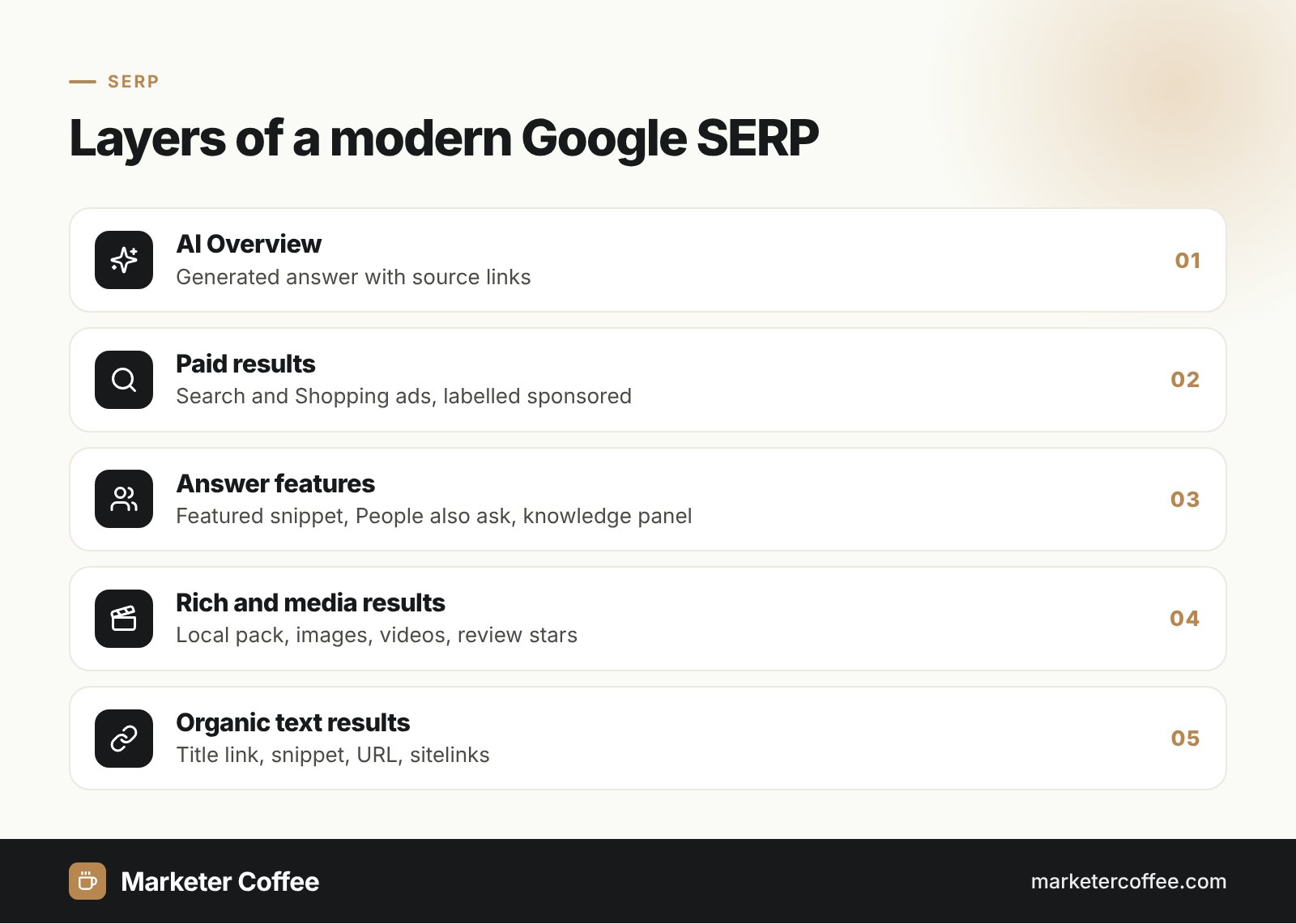
SERP features are every element beyond the classic text result. They fall into 4 groups, and each changes how many clicks reach regular listings.
Paid results
Search ads from Google Ads and Shopping ads appear above and below organic results and are labelled as sponsored.
Rich and media results
Rich results, image packs, video results and the local pack with a map present information visually and attract attention away from plain text listings.
Answer features
Featured snippets, knowledge panels from the Knowledge Graph and the “People also ask” group answer the question directly on the results page.
AI features
AI Overviews and AI Mode generate an answer with links to sources. Alphabet reported more than 100 million monthly AI Mode users in the US and India in July 2025.
How the SERP has evolved
The SERP evolved from a list of 10 blue links into a mixed, personalised page, and each milestone added a new layer:
| Year | Change | Effect on the SERP |
|---|---|---|
| May 2012 | Knowledge Graph | Entity panels built on 500 million objects at launch |
| March 2025 | AI Overviews in 9 European countries, including Germany and Poland | Generated answers in German, Polish and other local languages |
| July 2025 | AI Overviews in 200 countries and territories | About 2 billion monthly users, according to Alphabet |
Why the SERP matters for SEO and AI search
The SERP layout decides how much traffic a top ranking actually delivers. Pew Research Center tracked 900 US adults in March 2025 and found that users clicked a traditional result in 8% of visits when an AI summary appeared, compared with 15% without one, and clicked a link inside the summary in only about 1% of visits. Position 1 under an AI Overview, 4 ads and a local pack earns a different CTR than position 1 on a clean page.
That is why I analyse the SERP before choosing a keyword. The features Google shows reveal the search intent: a video carousel signals that people want to watch, a shopping block signals buying intent, an AI Overview signals an informational question. The practical goal today is to be visible in several places on one SERP: the organic listing, the rich result and the sources cited by the AI answer.
SERPs in international SEO
The same keyword produces a different SERP in each country and language. A query in Germany may show a local pack and German marketplaces, while the equivalent query in the Czech Republic shows Seznam-related results and Czech comparison sites. I always check SERPs from the target location and language (with Google’s gl and hl parameters or a rank tracker set to that market), because a SERP checked from Poland says little about Romania. Track positions separately per market, as described in my guide to measuring SEO results.
Want to know which SERP features you can win in each market? My international SEO consultancy starts with exactly this analysis.
Frequently asked questions about SERP
What does SERP stand for?
SERP stands for search engine results page. It is the page Google, Bing or another search engine shows after a user submits a query.
What are SERP features?
SERP features are elements beyond the standard text result, such as ads, featured snippets, knowledge panels, local packs, image and video results and AI Overviews. They change how many clicks reach organic listings.
Are SERPs the same for everyone?
No, Google adjusts results by location, language, device and search history. The same keyword can produce a different SERP in Warsaw and in Berlin.
How do AI Overviews change the SERP?
AI Overviews add a generated answer above organic results. Pew Research found that users clicked traditional results in 8% of visits with an AI summary, against 15% without one.
Related terms
- Visual elements gallery of Google Search · Google Search Central
- Search engine market share in Poland · Statcounter
- We're bringing the helpfulness of AI Overviews to more countries in Europe · Google
- Introducing the Knowledge Graph: things, not strings · Google
- Google's AI Overviews have 2B monthly users, AI Mode 100M in the US and India · TechCrunch
- Google users are less likely to click on links when an AI summary appears in the results · Pew Research Center