What does keyword research involve?
Keyword research involves collecting query ideas, measuring their demand and difficulty, and mapping each group of queries to one page. Google’s SEO Starter Guide frames it from the user’s side: think about the words someone would type to find your content, knowing that experts and beginners use different terms. Google matches synonyms well, so the goal is not every spelling variant but every distinct need.
Keyword research metrics
Every keyword is judged on 5 core metrics that together show its value and cost:
| Metric | What it shows | Where to get it |
|---|---|---|
| Search volume | Average monthly searches | Google Keyword Planner, Ahrefs, Semrush |
| Keyword difficulty | How hard it is to reach the top 10 | Ahrefs, Semrush, Senuto |
| Search intent | What the searcher wants: learn, compare, buy, find a site | Manual SERP review |
| CPC | What advertisers pay per click, a proxy for commercial value | Keyword Planner |
| SERP features | AI Overviews, snippets, maps, shopping ads that take clicks | Manual review, SEO tools |
The Backlinko study shows why volume alone misleads: the average keyword gets 989 searches a month, but the median is only 10. Demand is spread thin: even the top 500 terms account for just 8.4% of all search volume.
How to do keyword research in 5 steps
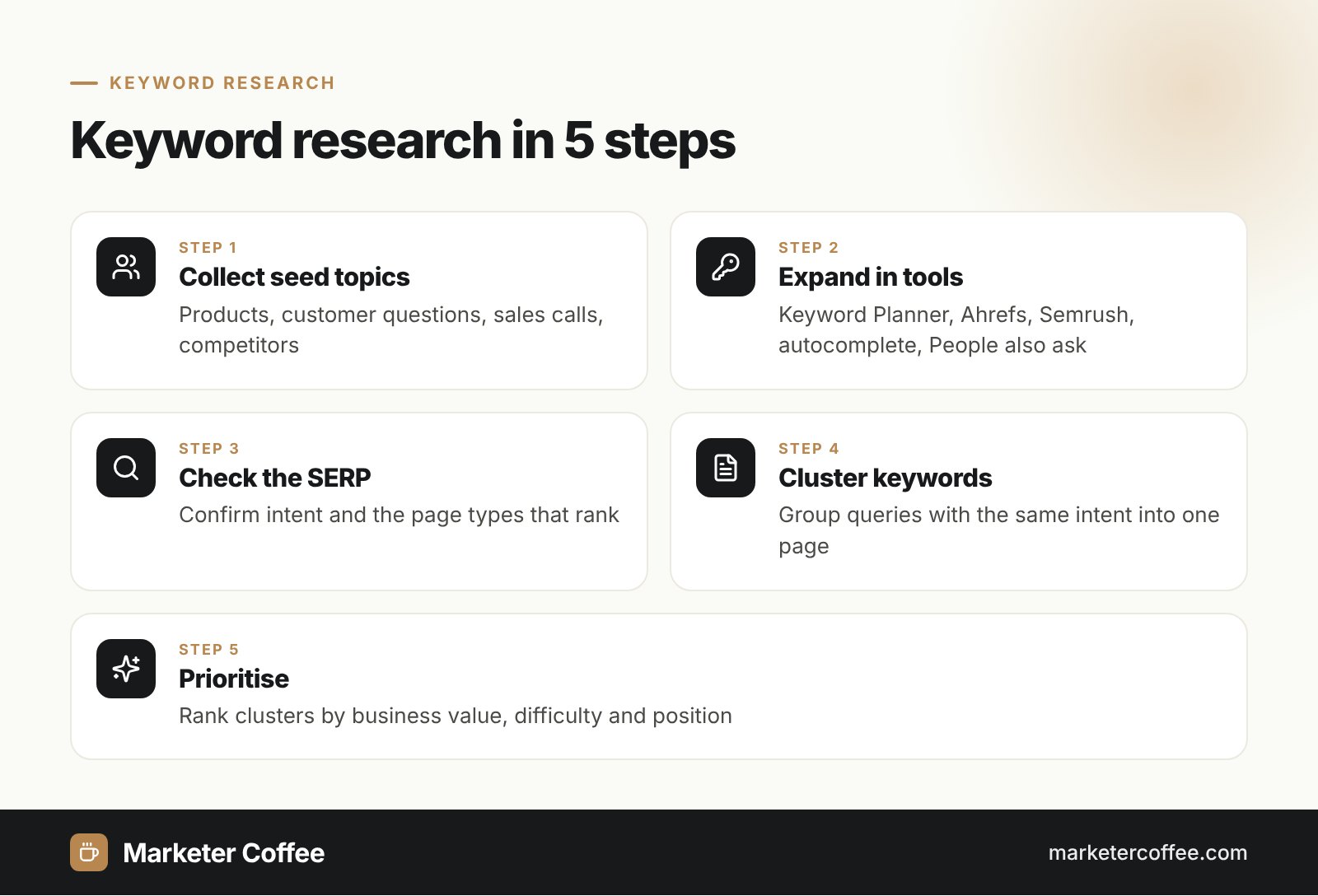
The process runs from seed topics to a keyword map where every page owns one cluster:
- List seed topics from your products, customer questions, sales calls and competitors’ navigation.
- Expand them in tools: Keyword Planner, Ahrefs or Semrush, plus Google autocomplete and “People also ask”.
- Check the SERP for each candidate to confirm intent and see which page types rank.
- Cluster keywords that share intent and ranking URLs into one topic per page.
- Prioritise clusters by business value, difficulty and current position, then assign them to new or existing URLs.
Step 4 protects you from keyword cannibalisation, where 2 of your pages compete for the same query. Step 5 turns research into a content plan that builds topical authority over time.
Keyword research in international SEO
International keyword research means researching each market from scratch in its own language instead of translating your home-market list. Search volume, phrasing and intent change between countries. In my projects for Polish brands entering Germany, the literal translation of a Polish category name often has a fraction of the volume of the term Germans really use, and Czech shoppers search with their own product names and abbreviations. I run the research in the target language with a native speaker, set the tool’s location and language to that country, and check the local SERP, because a query that is commercial in Poland can be informational in Germany. In the Czech Republic I also check Seznam suggestions, because Seznam still holds a meaningful share of Czech search.
Keyword research in the age of AI search
AI search changes keyword research from single queries to whole question sets. Backlinko found that 14.1% of keywords are questions, and AI Overviews and chatbots answer exactly those queries. Google’s guidance on helpful content warns against producing content mainly to attract search visits, so I treat keywords as evidence of real needs, not as phrases to repeat. Keyword stuffing also breaks Google’s spam policies. Today I extend each cluster with follow-up questions that tools like ChatGPT and Perplexity generate during query fan-out.
Want keyword research for several markets at once? See my international SEO consultancy or read how to build an SEO strategy on top of it.
Frequently asked questions about Keyword research
What is the best free keyword research tool?
Google Keyword Planner is the most common free option, available in a Google Ads account with billing details. Google Search Console is the best free source for queries your site already ranks for.
How many keywords should one page target?
One page should target one cluster of keywords that share the same intent and ranking URLs. A cluster can contain dozens of variants, but they all describe one need.
Can I translate keywords for other countries?
Translating keywords is not enough, because phrasing, volume and intent differ between markets. Research each country in its own language and check the local SERP before writing content.
How often should I do keyword research?
Do full keyword research before building a site or entering a market, then refresh it every quarter. Search Console data shows new queries and shifts in demand between those updates.
Related terms
- We Analyzed 306M Keywords. Here's What We Learned · Backlinko
- Use Keyword Planner · Google Ads Help
- SEO Starter Guide · Google Search Central
- Creating helpful, reliable, people-first content · Google Search Central
- Search engine market share Poland · Statcounter Global Stats