



What is Slack?
Slack is a chat tool for companies that replaces internal email with searchable channels organised by team, project or client. Users join a workspace, talk in public or private channels, send direct messages, start voice or video huddles and connect other software. The name comes from “Searchable Log of All Conversation and Knowledge”, as Stewart Butterfield explained in 2012.
History of Slack
Slack started as an internal tool at Tiny Speck, the studio behind the online game Glitch. When Glitch failed to become profitable in 2012, Butterfield and co-founders Eric Costello, Cal Henderson and Serguei Mourachov turned the chat tool into a product.
| Year | Milestone |
|---|---|
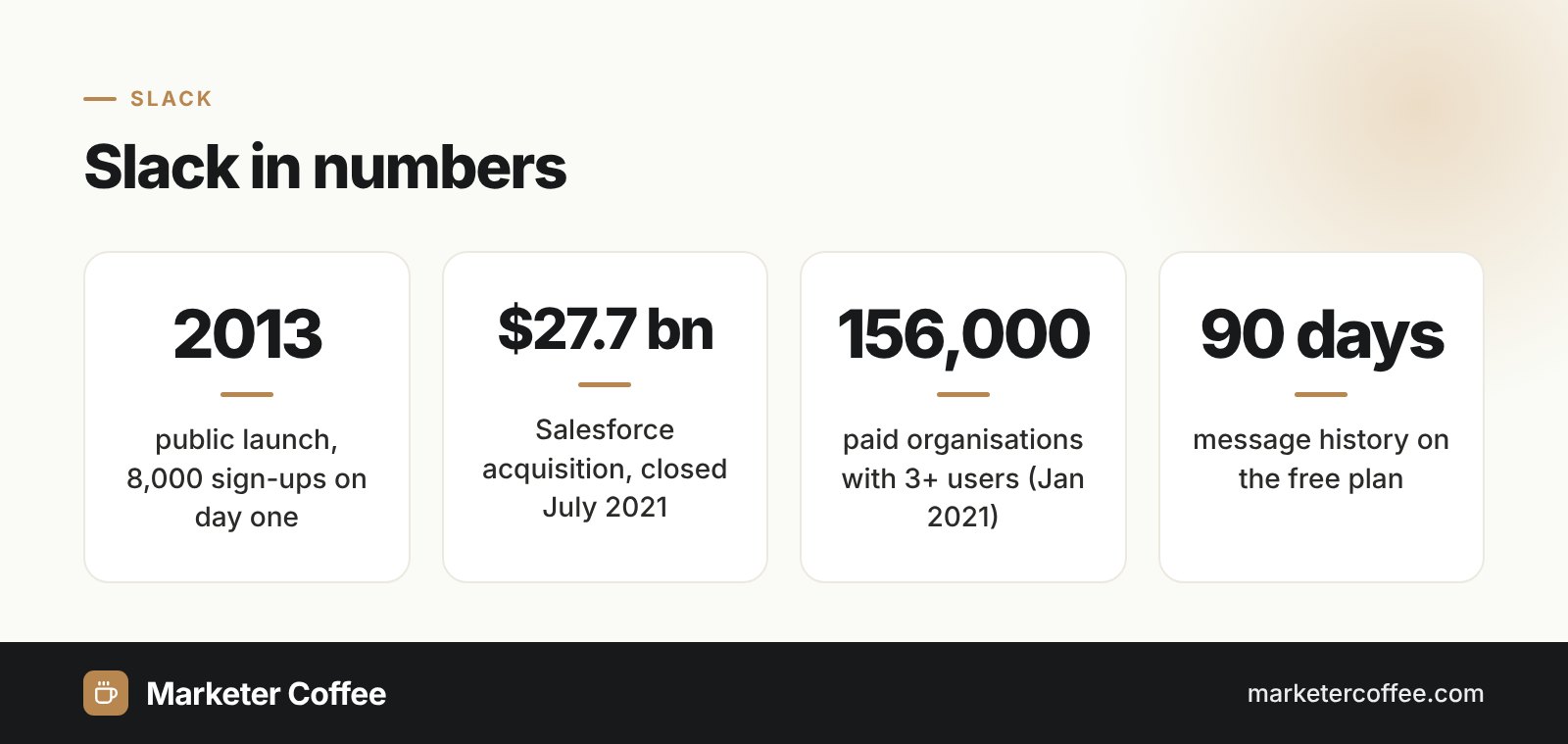
| 2013 | Public launch in August, 8,000 sign-ups in the first 24 hours |
| 2015 | More than 1 million daily active users by the end of the year |
| 2019 | Direct listing on the NYSE in June at a $19.5 billion valuation |
| 2020 | Salesforce announces the acquisition on 1 December |
| 2021 | Acquisition closes on 21 July for about $27.7 billion |
| 2026 | Slackbot relaunched as an AI agent powered by Anthropic’s Claude in January |
Key features of Slack
Slack combines five feature groups in one workspace, described in the H3s below.
Channels and messages
Channels group conversations by topic, while threads keep replies under the original message. Slack Connect channels let two companies work in one shared channel.
Huddles
Huddles are quick voice calls introduced in 2022, with video and screen sharing added later the same year. Free plans allow 2 participants and paid plans up to 50.
Apps and workflows
Slack connects with tools such as Google Drive, Asana, Trello, ClickUp and Figma. Workflow Builder automates routine requests without code.
AI features
Paid plans include channel and thread summaries and huddle notes. Business+ adds AI search, translations, daily recaps and Slackbot as a personal agent.
Search
Search covers messages and files. The free plan keeps 90 days of message history.
Slack pricing in 2026
Slack uses a freemium model with four plans, priced per active user per month on slack.com.
| Plan | Price per user per month (annual billing) | Key limit or feature |
|---|---|---|
| Free | $0 | 90 days of message history |
| Pro | $7.25 | Unlimited history, AI summaries |
| Business+ | $15 | Full AI suite, Slackbot agent |
| Enterprise+ | $45 | Enterprise search across connected systems |
Slack in marketing and SEO
Slack matters to marketing teams because it connects people, data and alerts in the place where they already talk. In my SEO projects I create a shared Slack Connect channel with the client’s team, which cuts approval time for content and technical fixes. Alerts from Google Search Console, uptime monitors, a CRM or rank trackers can post straight into a channel, so a drop in traffic is seen the same day. For agencies, a channel per client also keeps a searchable record of every decision, which helps when you report SEO results.
- Create one channel per client or project, with a clear naming rule.
- Route automated alerts into a separate channel to avoid noise.
- Pin briefs, brand guidelines and reporting links in each channel.
- Use huddles instead of scheduled calls for quick approvals.
Pros and cons of Slack
| Pros | Cons |
|---|---|
| Fast, searchable team communication | Constant notifications can hurt focus |
| Large app and integration ecosystem | Free plan hides messages older than 90 days |
| Shared channels with clients and partners | Per-user pricing adds up for large teams |
| Built-in AI summaries and search | Advanced AI only on higher plans |
Frequently asked questions about Slack
What is Slack used for?
Slack is used for team communication in channels, direct messages and voice or video huddles. Companies also use it to connect apps, automate workflows and work with clients in shared channels.
Who owns Slack?
Slack is owned by Salesforce, which completed the acquisition on 21 July 2021 for about $27.7 billion. Slack was founded by Stewart Butterfield and his team at Tiny Speck.
Is Slack free?
Slack has a free plan that keeps 90 days of message history. Paid plans start at $7.25 per user per month with annual billing for the Pro plan.
What does Slack stand for?
Slack is an acronym for Searchable Log of All Conversation and Knowledge. Stewart Butterfield shared this meaning in 2012.
Related terms
- Slack (software) · Wikipedia
- Salesforce completes $27.7bn acquisition of Slack · The Register
- Slack pricing · Slack
- Manage your language preferences · Slack Help Center
