



What is CRM?
CRM is a central database of contacts, companies, deals and interactions that sales, marketing and support teams share. Instead of spreadsheets and inboxes, every call, email, meeting and purchase sits on one customer record. The term covers both the business approach of building long-term customer relationships and the software that makes it possible, such as Salesforce, HubSpot, Microsoft Dynamics 365, Pipedrive or Zoho CRM.
How does a CRM system work?
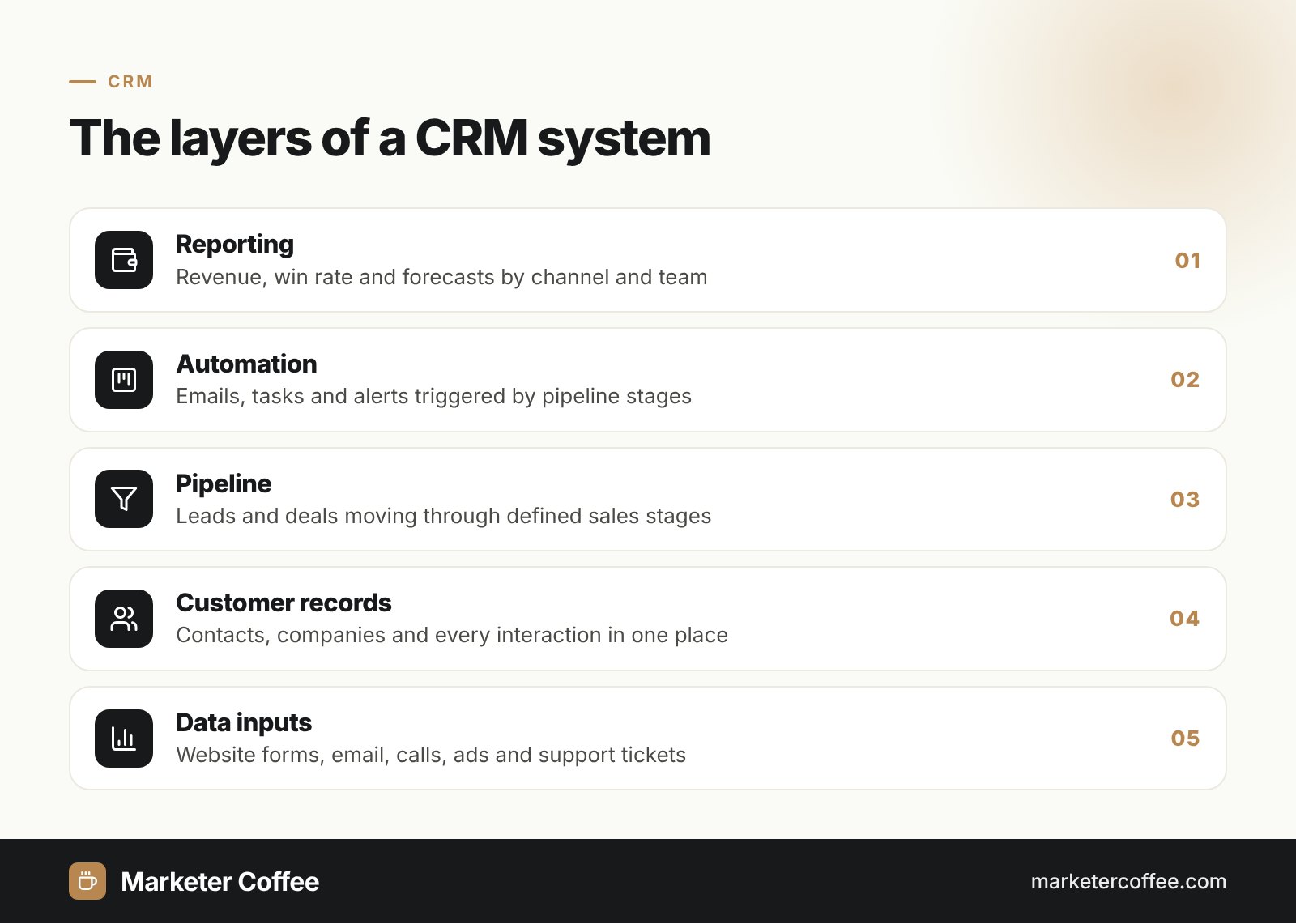
A CRM system works by collecting data from every touchpoint, organising it into records and pipelines, and triggering actions. A form fill on the website creates a lead, the lead moves through pipeline stages, and each stage can start an email, a task for a salesperson or a notification in Slack. Reports then show win rates, deal value and revenue forecasts.
Types of CRM
CRM software is usually divided into three types by main purpose, and most modern tools combine all three.
Operational CRM
Operational CRM automates sales, marketing and service processes: lead assignment, email sequences, ticket routing.
Analytical CRM
Analytical CRM turns customer data into insights, such as segments, customer lifetime value, churn risk and ARPU.
Collaborative CRM
Collaborative CRM shares customer context between departments and partners, so support sees open deals and sales sees open tickets.
CRM market in numbers
| Fact | Value | Source |
|---|---|---|
| Salesforce CRM market share, 2024 | 20.7% | IDC |
| Salesforce consecutive years as #1 CRM | 12 | IDC |
| Large EU enterprises using CRM, 2023 | 61% | Eurostat |
| Small EU enterprises using CRM, 2023 | 22% | Eurostat |
CRM in marketing and SEO
CRM matters to marketers because it connects marketing activity to revenue instead of stopping at clicks and form fills. When I set up SEO tracking for B2B and SaaS clients, I pass the landing page and source of each lead into the CRM, so we see which articles produce deals and not just traffic. That data also sharpens the ideal customer profile and shows which keywords bring buyers. The same closed-loop view feeds conversion optimisation and offline conversion imports in Google Ads.
- Track the first and last touch source on every contact.
- Send closed-won deals back to Google Ads and GA4 as offline conversions.
- Segment newsletters by lifecycle stage and industry.
- Score leads by fit and behaviour before passing them to sales.
CRM vs ERP
CRM manages the customer-facing side of a business, while ERP manages internal resources such as finance, inventory, production and payroll. Eurostat groups both, together with business intelligence, as e-business software. In practice the two are integrated: the CRM closes the deal, and the ERP invoices and ships it.
| Aspect | CRM | ERP |
|---|---|---|
| Main users | Sales, marketing, customer service | Finance, operations, HR |
| Core data | Contacts, deals, interactions | Orders, stock, invoices, costs |
| Main goal | Win and keep customers | Run internal processes efficiently |
How to choose a CRM
You choose a CRM by matching it to your sales process, team size and existing tools, not by feature count. For B2B and SaaS companies, which I cover in my B2B SaaS SEO guide, native integration with the website, ad platforms and product analytics usually matters more than advanced modules.
- Map your pipeline stages before you compare tools.
- Check integrations with your website forms, email and ad accounts.
- Confirm data hosting and GDPR terms for EU customers.
- Test the mobile app with the salespeople who will use it daily.
Pros and cons of CRM
| Pros | Cons |
|---|---|
| One source of truth for customer data | Value depends on data quality and discipline |
| Automation of repetitive tasks | Licence costs grow with users |
| Revenue reporting by channel | Implementation and training take time |
| Better handovers between teams | GDPR duties for stored personal data |
Frequently asked questions about CRM
What does CRM stand for?
CRM stands for customer relationship management. It refers both to the strategy of managing customer relationships and to the software that stores customer data and interactions.
What is the most popular CRM?
Salesforce is the largest CRM vendor, with a 20.7% market share in 2024 according to IDC. HubSpot, Microsoft Dynamics 365, Zoho and Pipedrive are other widely used systems.
What are the 3 types of CRM?
The three types are operational, analytical and collaborative CRM. Operational CRM automates processes, analytical CRM analyses data and collaborative CRM shares customer context between teams.
Does a small business need a CRM?
A small business benefits from a CRM once leads arrive from several channels or more than one person handles sales. Many tools offer free or low-cost plans for small teams.
Related terms
- Salesforce Ranked #1 CRM Provider for 12th Consecutive Year · Salesforce (IDC data)
- Use of e-business software by size of enterprise · Eurostat
- Polish Livespace CRM raises over 2.3M for the European expansion · Vestbee
