



From Not Indexed to 1,052 Monthly US Visits – 7 Articles, Zero Link Building
How we opened the US market for a Polish luxury fireplace brand with a site Google had never indexed. The method: one persona, the architect, and every fact localized for America.

International SEO Case Study
About the Client
Planika is a Polish luxury fireplace manufacturer known for bioethanol, gas and electric fireplaces designed for high-end residential and hospitality projects. Its buyers are rarely impulse shoppers. They are architects, interior designers and specifiers who select a fireplace years before a building opens.
The brand was established across Europe and wanted to expand into the United States, a market where it had no name recognition and no local search footprint. The problem: the new US B2B ecommerce site was not indexed in Google at all when we started. No traffic, no keywords, no history. A blank page in the world’s most competitive fireplace market.
“Seven articles beat seventy. We wrote for one persona in one country, and answered the questions an American architect actually has to answer before specifying a fireplace.”
Starting Point & Goals
- The domain was not indexed in Google, so the first job was getting crawled and discovered at all
- Move the brand beyond Europe and build demand in the US from zero
- Reach architects and specifiers, not casual shoppers: a B2B audience with technical questions
- Compete against established US manufacturers without buying links
- Prove the market with a small, high-quality content set before scaling budget
Results Overview
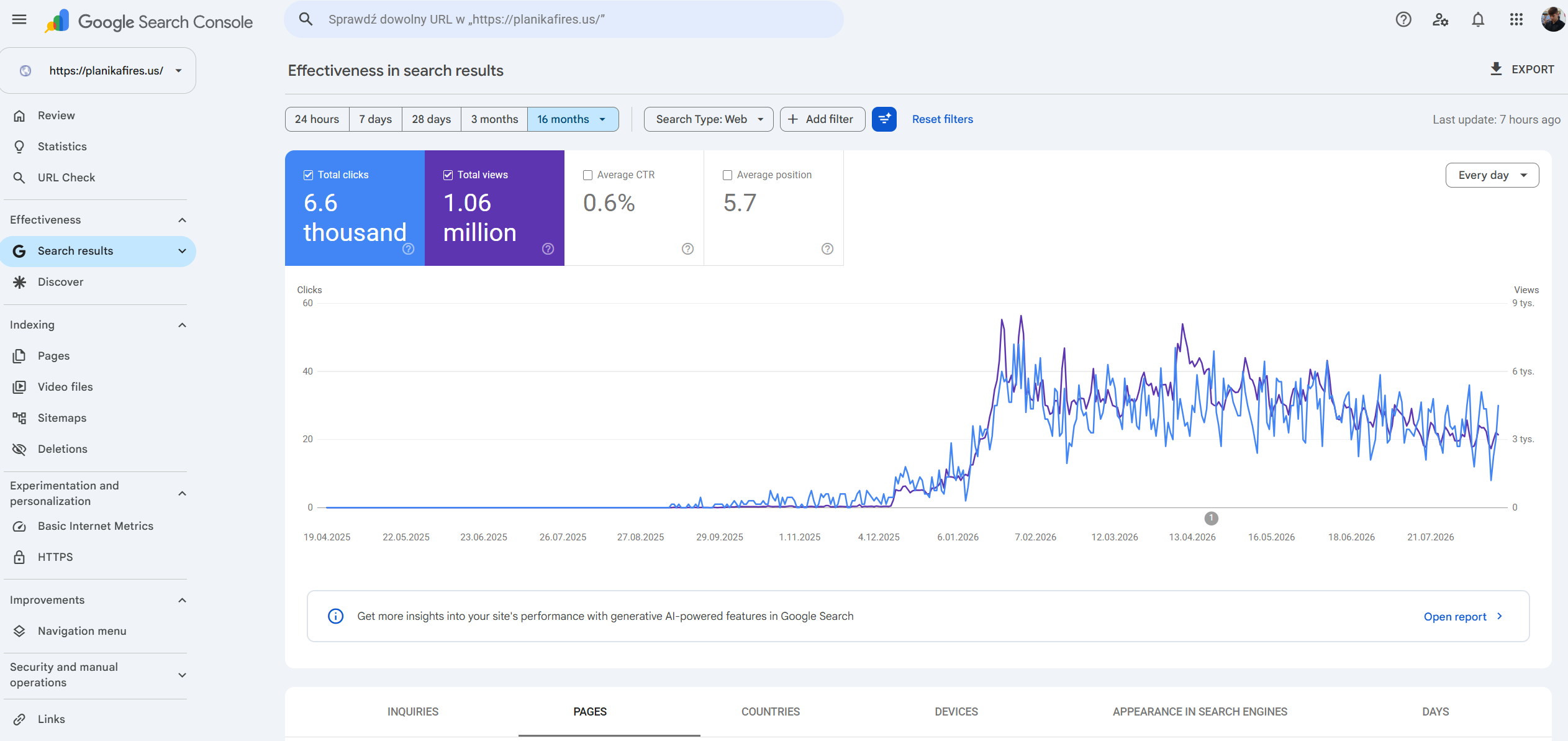
Google Search Console: Aug 10, 2025 → May 4, 2026
The curve below starts at absolute zero. Everything you see was produced by seven articles and the internal structure around them. No paid links, no PR, no legacy domain authority.
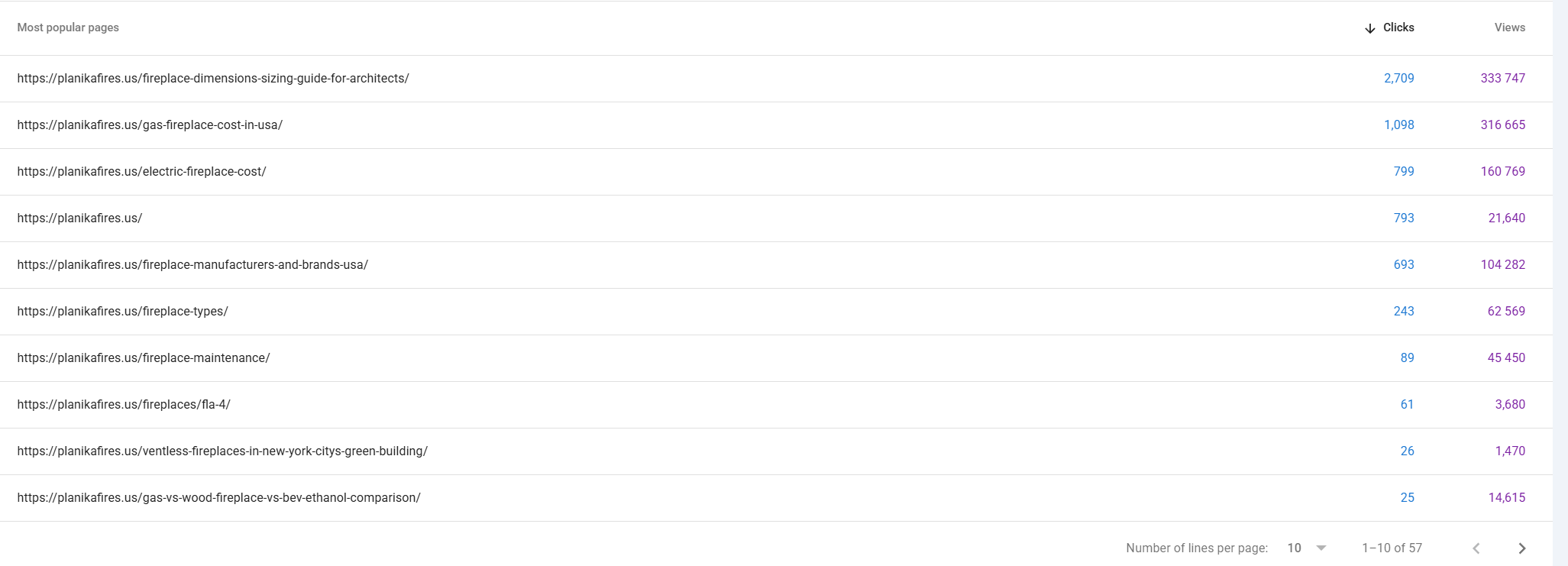
Clicks & Impressions by Article
Traffic is not spread thin across a large blog. It is concentrated in a handful of pages that answer decision-stage questions for the US market.
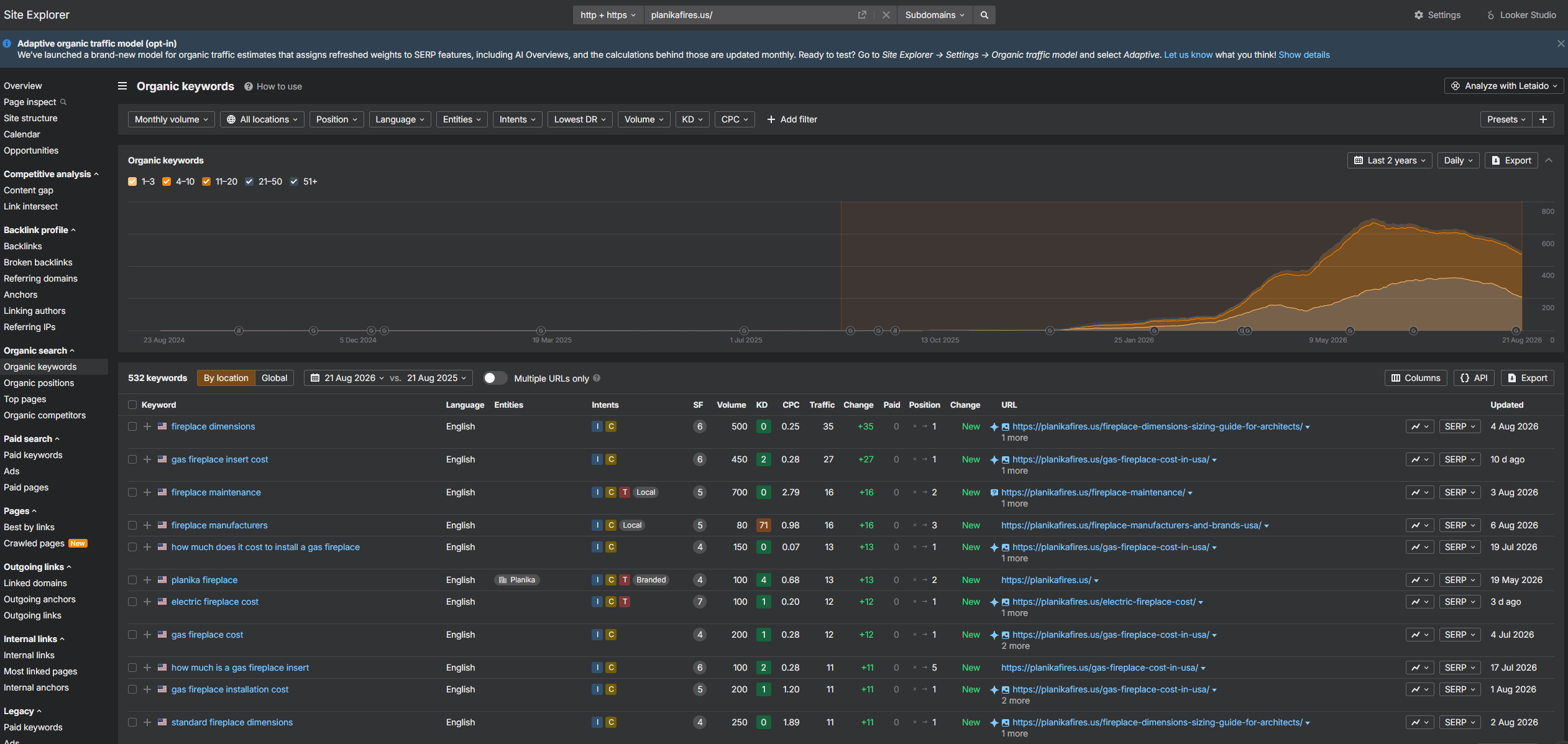
Ahrefs: Visibility, AI Overviews & Natural Links
Ahrefs confirms the same picture from the outside: rising US visibility, presence in Google AI Overviews and LLM answers, and a referring-domain curve that grew on its own because the pages became worth citing.
AI Visibility Breakdown
Answer-first writing pays twice. The same structure that wins featured positions in Google also gets the pages pulled into AI answers. Mentions recorded by Ahrefs across AI surfaces:
| Metric | Result |
|---|---|
| Starting point | Domain not indexed in Google |
| Monthly organic visits | 1,052 (May 4, 2026) |
| US ranking keywords (peak) | 882 |
| Keywords in Top 3 | 286 |
| Keywords in Top 10 | 460 |
| Link building | None. Referring domains grew naturally |
| AI visibility | 401 AI Overviews, 173 AI Mode, 136 Perplexity, 70 Gemini, 20 ChatGPT, 7 Copilot |
| Content produced | 7 US-localized articles for the architect persona |
What We Implemented
1) One Persona: The Architect
- Every article was written for the person who specifies a fireplace, not the person who browses one
- Content answers specification questions: dimensions, clearances, fuel type, running cost, maintenance load
- A tight persona produced a tight topical scope, which is why 7 pages could outrank far larger blogs
2) Real US Localization (Not Translation)
- US units throughout (inches, feet, BTU, USD), because dimension and cost queries fail without them
- US sizing standards: fireplace dimensions differ by country because building codes differ, so we wrote the American version of the answer
- US manufacturers named in ranking articles, because an American architect compares against brands sold in America, not European ones
- US pricing reality: gas and electric fireplace costs quoted in the ranges the local market actually sees
3) The Seven Articles
| Topic | Why it wins in the US |
|---|---|
| Fireplace dimensions by type | Sizing standards are code-dependent; we published the US-specific numbers |
| Gas fireplace cost in the US | Budget question that decides the spec, answered in USD with install context |
| Electric fireplace cost in the US | Same intent, different fuel. Captures the comparison shopper mid-decision |
| Top US fireplace manufacturers | Ranking page built around brands available in America, not Europe |
| Types of fireplaces | Top-of-funnel hub that feeds every other article through internal links |
| Differences between fireplace types | Comparison intent: the query an architect runs before narrowing the shortlist |
| Fireplace maintenance | Lifetime-cost objection handled before it reaches the sales conversation |
4) Semantic SEO Execution
- Articles written to a defined SEO brief by a copywriter trained specifically in semantic SEO
- Direct answers first, then supporting detail, the format Google and LLMs both quote
- Consistent entity coverage across fuel types, dimensions, costs and maintenance so the site reads as one coherent body of knowledge
5) Visual Semantics
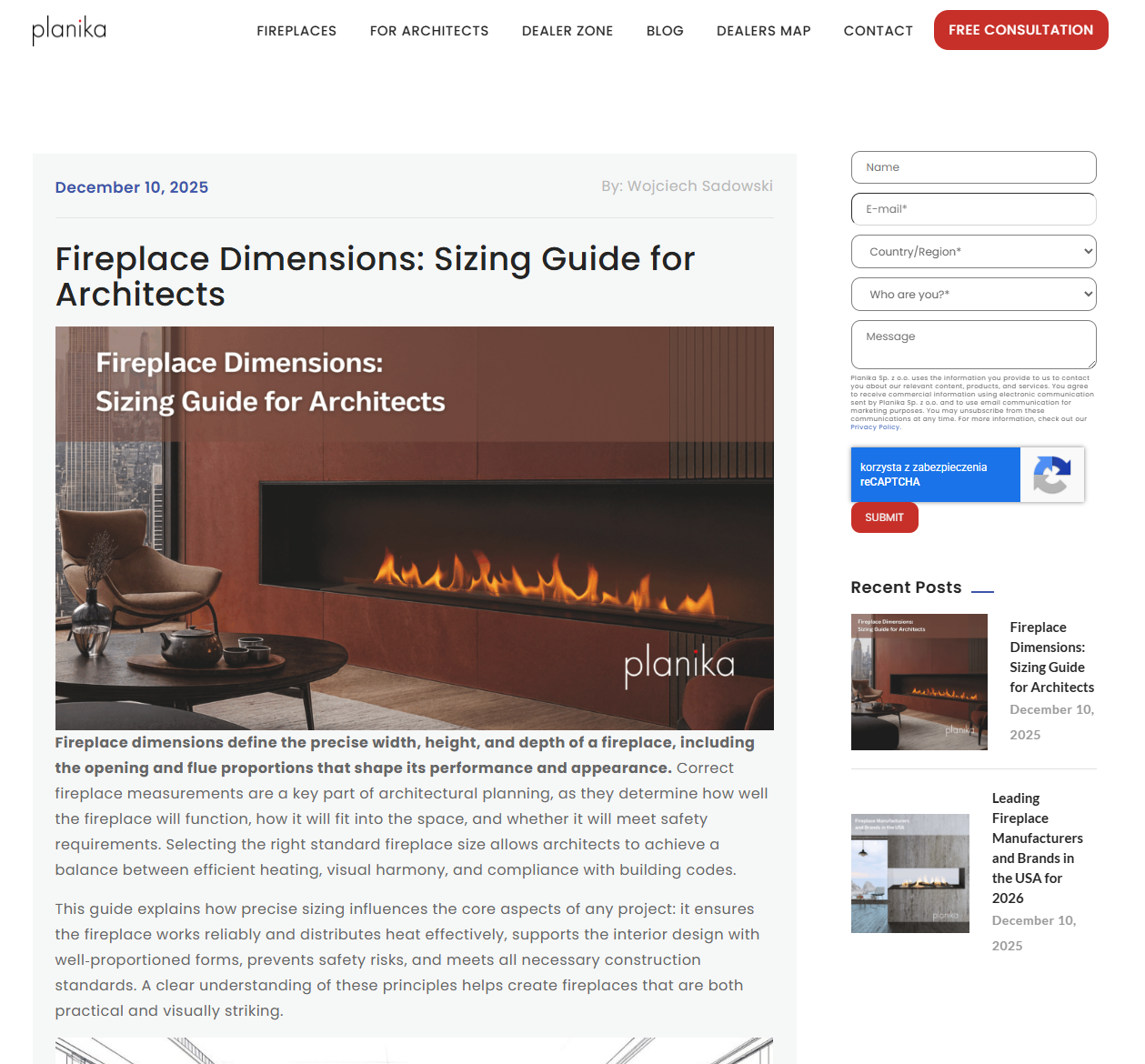
Images were produced to a spec, not picked from a library. Every graphic carries the article heading for context, the brand logo, and a real example of the fireplace arrangement being discussed, so the visual reinforces the same meaning as the text. This is visual semantics, a concept developed by Koray Tuğberk Gübür.
Challenges & Solutions
!The site wasn’t in Google at all
Response: Fixed crawling and indexing first, then gave Google a clear reason to return: a defined topical scope published in a steady sequence rather than one bulk drop.
!European content doesn’t rank in America
Response: Rebuilt the facts, not the wording. US units, US codes, US price ranges, US manufacturers. A translated European article would have matched the keyword and failed the intent.
!No authority, no budget for links
Response: Won on relevance and answer quality instead. Referring domains grew on their own once the pages became the most useful result for the query.
!A B2B audience with low tolerance for fluff
Response: Numbers, tables and clearances up front. Architects are checking whether a product fits a drawing, so the content had to be usable at that level.
Project Timeline
Key Takeaways
What Moved the Needle
- Pick one persona. Writing for the architect made every topic decision obvious.
- Localize the facts, not the language. Units, codes, prices and competitor names decide whether a page belongs in a US SERP.
- Depth beats volume. Seven complete answers outperformed competitors with hundreds of shallow posts.
- Design images to mean something. Visual semantics reinforce the topic instead of decorating it.
- Links follow value. We built none, and referring domains still grew.
A new market does not require a new budget the size of the incumbent’s. It requires knowing exactly who you are writing for and being factually native to the country you are entering.
We took an unindexed domain to 1,052 monthly organic visits in the United States with seven articles and no link building.
Entering a New Market?
Book a review with Marketer Coffee. We’ll define your buyer persona, map the topics that market actually searches, and outline a 90-day plan you can start tomorrow.
Planika Fires – From Not Indexed to 1,052 monthly US Visits – 7 Articles, Zero Link Building
Home/Case studies/Planika From Not Indexed to 1,052 Monthly US Visits – 7 Articles, Zero Link Building How we opened the US market for a Polish luxury fireplace brand with a site Google had never indexed. The method: one persona, the architect, and every fact localized for America. Book a Strategy Call Jump to results International […]