
SEO in Poland is the process of optimizing a website to rank higher on search engines within the Polish market. Poland is the largest economy in Central and Eastern Europe, with a nominal GDP that crossed the $1 trillion threshold in 2025, according to the IMF, making it the 20th-largest economy in the world. The Polish e-commerce market reached an estimated PLN 150 billion+ in 2025 (approximately $36 to 37 billion), according to the Warsaw Enterprise Institute citing Central Statistical Office data. Search engine optimization in the Polish market, also referred to as Polish SEO or pozycjonowanie stron, targets 34.5 million internet users who search predominantly in Polish on Google.pl.
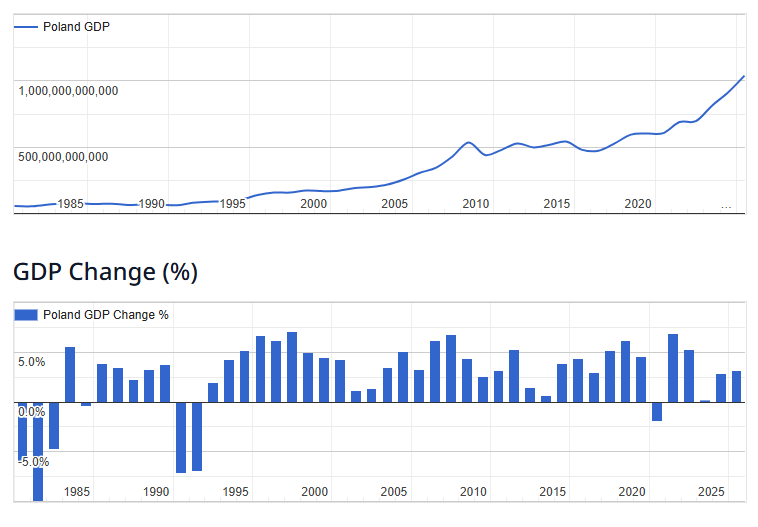
source: https://www.worldometers.info/gdp/poland-gdp/
This article covers the structure of the Polish digital market, how Polish search behavior differs from Western European markets, which search engines and marketplaces dominate Poland, how local SEO works across Polish cities and regions, and what foreign companies need to know when entering the Polish market through organic search.
What Is SEO in Poland?
SEO in Poland is the practice of improving a website’s visibility in organic search results on Google.pl, the dominant search engine in the Polish market. In Polish, SEO is commonly referred to as “pozycjonowanie stron” (website positioning) or “optymalizacja pod wyszukiwarki.”
Polish-market SEO differs from SEO in Western European countries due to three factors: the linguistic complexity of the Polish language (a West Slavic language with seven grammatical cases that affect keyword targeting), the dominance of Google.pl with approximately 95.7% market share across all devices as tracked by StatCounter, and the presence of local platforms such as Allegro and Ceneo.pl that shape how Polish consumers discover and compare products online.
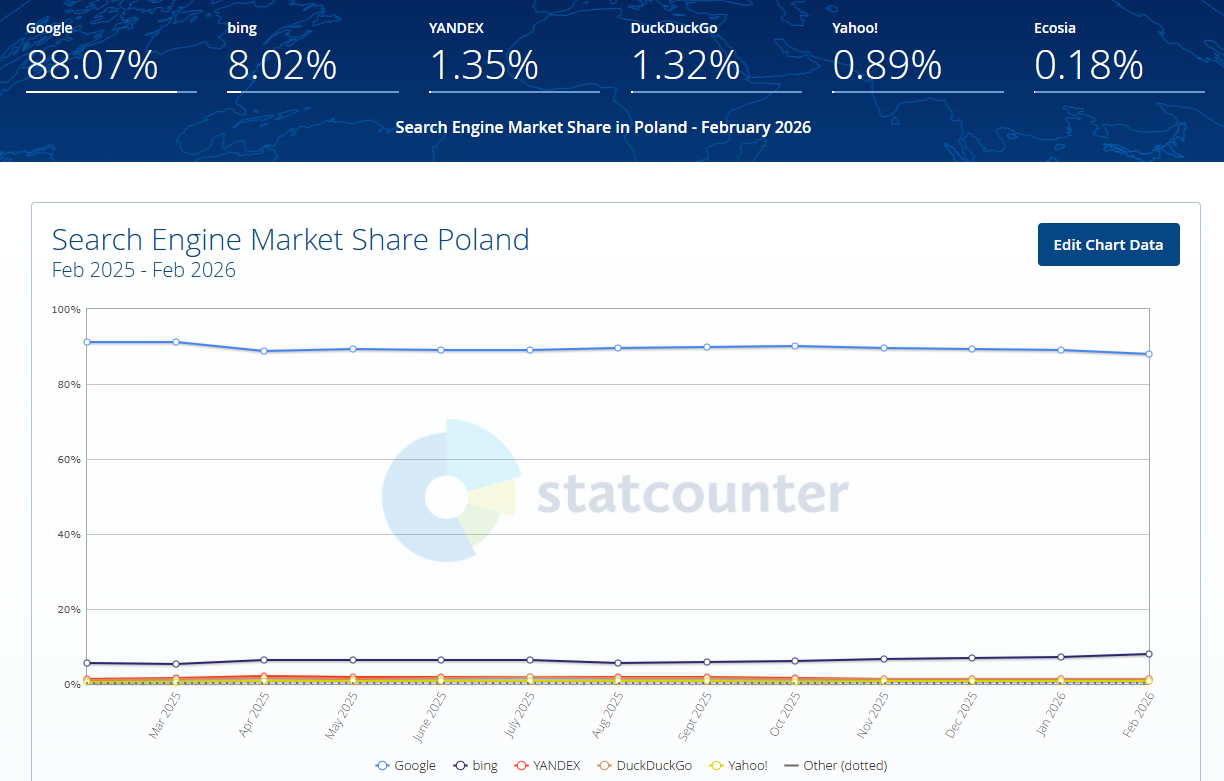
source: https://gs.statcounter.com/search-engine-market-share/all/poland
How Big Is the Polish Digital Market?
The Polish digital market is the largest in Central and Eastern Europe by both internet user count and e-commerce revenue. Three key metrics define the scale of this market: internet penetration, e-commerce revenue, and GDP. For marketing directors and growth leaders evaluating CEE market entry, Poland represents the single largest organic search opportunity in the region.
How Many People Use the Internet in Poland?
34.5 million people used the internet in Poland as of January 2025, according to DataReportal’s Digital 2025 report. Internet penetration stood at 89.8% of the total population (38.4 million). Statistics Poland (GUS) reported that 96.2% of Polish households had internet access in 2025, an increase of 0.3 percentage points from 2024. Mobile broadband access grew by 2.3 percentage points to 78.2%, while fixed broadband stood at 70.3%.
How Large Is the Polish E-commerce Market by Revenue?
The Polish e-commerce market reached an estimated PLN 150 billion+ in 2025 (approximately $36 to 37 billion), according to the Warsaw Enterprise Institute citing Central Statistical Office data. Online retail sales grew 9.4% year-over-year in January 2025. The Polish e-commerce market achieved a CAGR of 17.4% between 2020 and 2024, according to Research and Markets. Strategy& forecasts the market will reach PLN 192 billion by 2028.
69.7% of Poles aged 16 to 74 purchased goods or services online in 2025, a 2.3 percentage point increase from 2024, according to Statistics Poland. Smartphones captured 64.67% of consumer e-commerce spend in 2025, according to Mordor Intelligence.
What Is the GDP of Poland?
The nominal GDP of Poland reached $1.04 trillion in 2025, according to the International Monetary Fund (IMF). Poland crossed the symbolic $1 trillion GDP threshold in 2025, becoming the 20th-largest economy in the world. GDP growth reached 3.2% in 2025. The IMF projects Poland’s GDP growth will accelerate to 3.5% in 2026, driven by EU fund execution and monetary easing.
Which Search Engines Do Poles Use?
Poles use Google as the dominant search engine, with approximately 95.7% market share across all devices. Google’s dominance in Poland is significantly higher than in the United States (85 to 87%) or Germany (~90%). The table below shows search engine market share in Poland as of 2025:
| Search Engine | Poland Market Share (all devices) | Notes |
|---|---|---|
| ~95.7% | Higher than EU average | |
| Bing | ~2.8% | Growing due to Copilot AI integration |
| DuckDuckGo | ~0.9% | Privacy-focused, niche user base |
| Yahoo | ~0.3% | Marginal presence |
| Google (mobile only) | ~98.5% | Near-total mobile dominance |
Source: StatCounter Global Stats (2024 to 2025 data).
Google’s 95.7% share in Poland means SEO strategy for the Polish market is effectively Google-only strategy. Bing’s 2.8% share is too small to justify a separate optimization effort for most businesses. On mobile devices, Google’s share in Poland reaches 98.5%, making mobile SEO on Google.pl the primary channel for reaching Polish consumers.
How Does Polish Search Behavior Differ from Western European Markets?
Polish search behavior differs from Western European markets in language complexity, platform preferences, and the role of local marketplaces in the purchase journey. These differences affect keyword research, content strategy, and conversion optimization for Poland-targeted SEO. For marketing directors evaluating CEE expansion, understanding these differences determines whether a Polish SEO campaign generates revenue or wastes budget on irrelevant traffic.
Why Does the Polish Language Make SEO More Complex?
The Polish language makes SEO more complex because Polish has seven grammatical cases that change the form of nouns, adjectives, and numerals depending on their function in a sentence. A single keyword such as “buty” (shoes) appears in search queries as “buty,” “butów,” “butom,” “butami,” “butach” depending on the grammatical context. Google.pl recognizes many of these inflected forms as related queries, but keyword research must account for all major declension variants to capture full search volume.
Polish also uses diacritical characters (ą, ć, ę, ł, ń, ó, ś, ź, ż) that affect search matching. Users search both with and without diacritics. A complete keyword strategy for the Polish market targets both “łóżko” and “lozko” (bed), “żółty” and “zolty” (yellow), and similar pairs. Ignoring diacritical variants reduces organic search visibility by 10 to 20% for affected keywords.
Where Do Polish Consumers Start Their Online Shopping Journey?
Polish consumers start their online shopping journey on Allegro, Google, and Ceneo.pl. Allegro is Poland’s dominant e-commerce marketplace, comparable to Amazon’s role in the US market. Ceneo.pl is Poland’s largest price comparison engine, used by Polish consumers to compare prices across online stores before purchasing. 30% of Polish internet users purchase from international stores, according to Statista, but the majority of product discovery starts on Polish-language platforms.
For SEO purposes, this means Polish content must target informational and comparison queries on Google.pl, where Allegro’s dominance is weaker. Product-specific transactional queries often show Allegro and Ceneo.pl results in the top positions, making informational content and category-level targeting more effective for independent online stores.
What Role Does Mobile Play in Polish Search and E-commerce?
Mobile devices account for 64.67% of consumer e-commerce spend in Poland in 2025, according to Mordor Intelligence. Google’s mobile search share in Poland reaches 98.5%. Mobile commerce is growing at a 9.28% CAGR, the highest rate among all device categories in Poland. Mobile-first indexing and Core Web Vitals performance on mobile devices are critical ranking factors for Polish-targeted websites.
What Are the Top E-commerce Platforms in Poland?
The top e-commerce platforms in Poland are Allegro (#1, dominant marketplace), Media Expert (#2), AliExpress (#3), Ceneo.pl (top 5, price comparison), and Amazon.pl (growing), according to ECDB E-commerce Database 2024.
| Rank | Platform | Position |
|---|---|---|
| 1 | Allegro | Dominant marketplace |
| 2 | Media Expert | #2 by traffic |
| 3 | AliExpress | #3, cross-border |
| 4 | Ceneo.pl | Top 5, price comparison |
| 5 | Amazon.pl | Growing market share |
Source: ECDB E-commerce Database 2024.
IdoSell is the leading e-commerce platform software in Poland, according to ECDB. DPD is the most widely offered shipping provider among Polish e-commerce retailers. 18,000 new SME online stores launched in Poland in 2024 alone, a 34% year-over-year increase, according to Mordor Intelligence. InPost parcel lockers (Paczkomaty) with 25,000+ locations nationwide are a defining feature of Polish e-commerce logistics.
What Payment Methods Do Polish Consumers Prefer?
Polish consumers prefer BLIK as the dominant payment method for online purchases. BLIK is a mobile payment system unique to Poland, used by 76% of Polish online shoppers. BLIK processed transactions that made it the single most popular checkout method in Polish e-commerce.
The full payment landscape in Poland differs significantly from Western European markets:
| Payment Method | Usage Share | Notes |
|---|---|---|
| BLIK | ~76% | Dominant, mobile-native, unique to Poland |
| Online bank transfers (Pay-by-Link) | ~27% | Traditional, widely trusted |
| Credit/debit cards | ~19% | Lower than Western Europe |
| Buy Now, Pay Later (BNPL) | Growing | Allegro Pay, Klarna, EUR 2.54B in 2024 |
| Cash on delivery | Declining | Still used outside major cities |
Source: Landing page data, Mordor Intelligence, ECDB.
BNPL transaction value in Poland reached EUR 2.54 billion ($2.78 billion) in 2024, according to Mordor Intelligence citing Eurostat data. Allegro Pay processed PLN 3.2 billion ($800 million) in the first nine months of 2024. Foreign companies entering the Polish market must integrate BLIK into their checkout flow. Polish consumers expect BLIK as a payment option, and stores without BLIK integration experience higher cart abandonment rates.
What Is the Difference Between Polish and English in SEO?
The difference between Polish and English in SEO is grammatical complexity, character encoding, and search intent structure that fundamentally change how keyword research and content creation work. A direct translation of English content into Polish underperforms because Polish search queries follow different linguistic patterns.
Key differences between Polish and English SEO:
| Feature | English | Polish | SEO Impact |
|---|---|---|---|
| Grammatical cases | None | 7 cases | One keyword has multiple inflected search forms |
| Diacritical characters | None | 9 (ą, ć, ę, ł, ń, ó, ś, ź, ż) | Must target both diacritic and non-diacritic variants |
| Word order | Fixed (SVO) | Flexible | More keyword phrase combinations to target |
| Gendered nouns | No | Yes (3 genders) | Adjectives change form based on noun gender |
| Average word length | Shorter | Longer | Title tags and meta descriptions need more characters |
Polish content must be written by native Polish speakers. Machine-translated or non-native content produces incorrect grammatical forms that reduce search relevance. Google.pl ranks native Polish content significantly higher than translated content for local queries.
How Does Local SEO Work in Poland?
Local SEO in Poland targets search queries that include a city, voivodeship (województwo), or regional modifier, such as “agencja SEO Warszawa” or “sklep internetowy Wrocław.” Poland has 16 voivodeships, 314 cities with municipal status (miasta na prawach powiatu and gminy miejskie), and significant regional economic differences between major urban centers.
Google Business Profile (GBP) is the primary tool for local SEO visibility in Poland. Polish local search results display Google’s Local Pack for city-level queries. BrightLocal’s 2024 Local Consumer Review Survey found that consumer behavior patterns in local search are consistent across European markets, with Google serving as the primary evaluation tool.
Polish local SEO targets five major metropolitan markets. Warsaw (Warszawa) is the largest market with 1.8 million residents and the highest search volume across all commercial categories. Kraków is the second-largest market, strong in tech, education, and tourism queries. Wrocław is a growing tech and services hub. Poznań and the Tri-City (Gdańsk-Gdynia-Sopot) represent additional high-value local markets. Each city requires separate landing pages with location-specific content, local citations in Polish directories (Panorama Firm, PKT.pl, Zumi.pl), and consistent NAP (Name, Address, Phone) data.
What Is E-E-A-T and Why Does It Matter for Polish SEO?
E-E-A-T stands for Experience, Expertise, Authoritativeness, and Trustworthiness. Google introduced this framework in its Search Quality Rater Guidelines to evaluate content quality. E-E-A-T applies to Google.pl the same way it applies to all Google regional search engines.
E-E-A-T is especially important for Polish-market SEO in YMYL (Your Money or Your Life) categories. Poland has a growing number of authoritative Polish-language publishers competing for high-value search queries in health, finance, legal, and insurance sectors. Polish-targeted content builds E-E-A-T through four elements. Author bios with verifiable Polish credentials demonstrate expertise. Citations from Polish institutions such as GUS (Statistics Poland), NBP (National Bank of Poland), and Polish academic sources demonstrate authoritativeness. Original data and Polish-market research demonstrate experience. Clear editorial policies in Polish demonstrate trustworthiness.
How Can a Foreign Company Build an SEO Strategy for the Polish Market?
A foreign company builds an SEO strategy for the Polish market by addressing four areas: domain structure, content localization, geotargeting configuration, and Polish-specific backlink acquisition. Each area directly affects how Google.pl indexes and ranks the website for Polish users. For CEOs and marketing directors leading Central European expansion, these four decisions determine the speed and cost of organic market entry into Poland.
What Domain Structure Works Best for Polish Market Entry?
Three domain structures work for Polish market targeting. A .pl country-code domain (example.pl) sends the strongest geotargeting signal to Google.pl and increases trust among Polish consumers. A country-specific subdirectory (example.com/pl/) consolidates domain authority under one root domain. A subdomain (pl.example.com) separates Polish content while maintaining brand connection. Google’s documentation confirms that all three structures are valid for geotargeting. A .pl domain is the strongest option for companies committed to long-term Polish market presence.
How Does Hreflang Work for Polish Content?
Hreflang tags tell Google which language and regional version of a page to serve to users in different locations. For a company targeting both the Polish and English-speaking markets, hreflang implementation requires separate language codes: pl for Polish content and en (or en-us, en-gb) for English versions. Incorrect hreflang implementation causes Google to serve the English version to Polish users, reducing click-through rates and increasing bounce rates.
How Do You Build Polish-Specific Domain Authority?
Polish-specific domain authority requires backlinks from Polish-language websites. Links from English-language international domains carry less weight for Polish-targeted rankings. Polish link building follows four steps. Identify authoritative Polish publications, industry portals, and regional news sites. Develop digital PR campaigns that secure coverage on Polish media outlets and industry-specific Polish blogs. Submit listings to Polish business directories such as Panorama Firm, PKT.pl, and government resources such as biznes.gov.pl. Monitor domain authority growth and adjust outreach volume based on competitive gap analysis.
Building a Polish SEO strategy from outside Poland requires deep knowledge of the Polish language, local search behavior, competitive landscape, and technical implementation specific to Google.pl. If you are a company looking to enter or scale in the Polish market, Marketer Coffee is a Polish SEO agency based in Wrocław that helps companies build and implement data-driven SEO strategies tailored to the Polish market, from domain architecture and hreflang setup to native Polish content strategy and local link building.
Book a free consultation to discuss your Polish market entry plan.
FAQ — SEO in Poland
How long does it take to rank on Google.pl?
Ranking on Google.pl takes 4 to 8 months for moderately competitive keywords and 8 to 18 months for highly competitive terms. Polish-market competition is lower than in the US or UK for most keyword categories, which shortens ranking timelines compared to English-language markets. The timeline depends on three factors: the website’s existing domain authority, the competitiveness of the target keyword in Polish, and the quality of Polish-language content and backlink strategy.
How much does SEO cost in Poland?
SEO services for the Polish market cost between PLN 3,000 and PLN 15,000+ per month (approximately EUR 700 to EUR 3,500+), depending on scope, competition level, and agency expertise. Enterprise-level Polish SEO campaigns targeting competitive national keywords cost PLN 10,000 to PLN 30,000+ per month. Polish SEO pricing is lower than US or UK SEO pricing due to lower labor costs, but the quality of strategy and execution from top Polish agencies is competitive with Western European agencies.
Is Allegro important for SEO in Poland?
Allegro is important for e-commerce visibility in Poland but operates as a separate search ecosystem from Google.pl. Allegro has its own internal search algorithm and ranking factors. Allegro product listings also appear in Google.pl organic search results for product-related queries. A comprehensive Polish e-commerce SEO strategy optimizes for both Google.pl and Allegro’s internal search, treating them as complementary channels.
What is the biggest mistake companies make when entering the Polish market with SEO?
The biggest mistake is using machine-translated content instead of native Polish copy. Machine translation produces grammatically incorrect Polish that reduces search relevance and destroys user trust. Polish has seven grammatical cases, three genders, and complex verb conjugation that automated translation tools handle poorly. The second most common mistake is ignoring BLIK as a payment method, which increases cart abandonment rates among Polish consumers who expect BLIK at checkout.
Can a company rank in Poland without a Polish office?
A company can rank in Poland without a Polish office, but a physical Polish presence adds relevance signals that strengthen Polish-targeted rankings. Google uses location-related signals including server location, local business listings, Polish-based backlinks, and Google Business Profile data. A Polish office enables registration in local directories, strengthens local SEO for city-level queries, and increases trust signals for Polish users.
Companies without a Polish office compensate through four elements. Polish-hosted CDN infrastructure reduces latency for Polish users and signals geographic relevance. Hreflang tags with pl targeting direct Google to serve the correct regional version. Polish-based backlink profiles built through digital PR on Polish publications replace the authority that a local presence provides. Native Polish content written by Polish speakers matches the vocabulary, grammar, and phrasing Polish users expect.
A Polish office is not a requirement for ranking, but it is a competitive advantage. Companies that plan long-term Polish market expansion benefit from establishing a physical presence that unlocks local SEO opportunities unavailable to remote-only operations.